

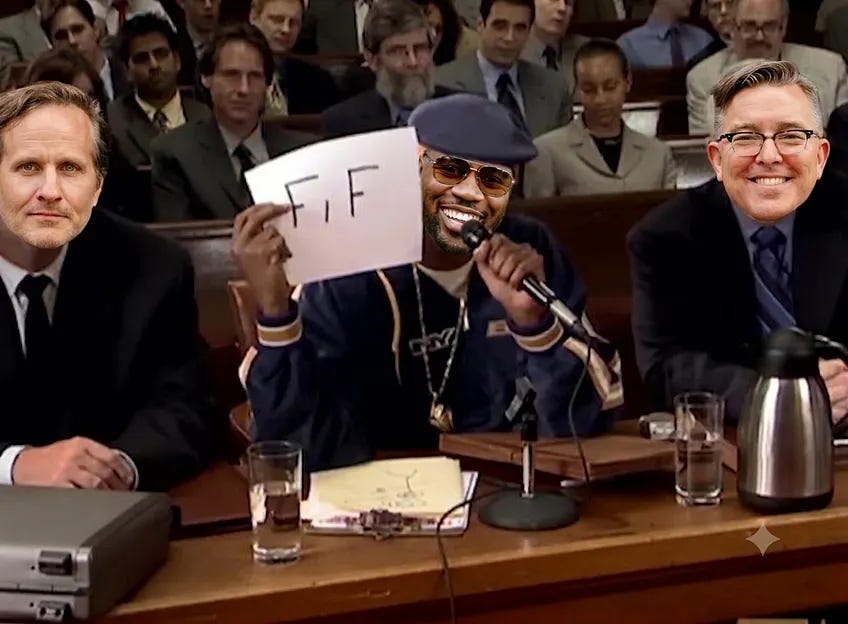
Since all work and no play makes Jack wander through the empty halls of the haunted hotel with a butcher knife, we do occasionally step out into the sunshine and (for a change!) enjoy a cocktail or seven. Such, such were the joys of last night’s annual Osprey Blues Festival hosted this Saturday by our partner in crimes, Jonathan Farber. You’d think we woulda snapped some Fif’ pics on this rare public/private outing, but instead we will torture you with horrid listener-created A.I. art.
* As mentioned here previously, at the end of Members Only #339, fired ABC News veteran Terry Moran spilled tea about “the one time I did feel the heavy hand of censorship.” It was spring of 2021, the day that Nightline was scheduled to air his long-gestated piece on the Covid lab-leak hypothesis, and the segment came back with edits rendering it “incomprehensible,” thanks in part (he was told) to some pre-screening by none other than Anthony Fauci:
Unsurprisingly, this revelation attracted notice: In Mediaite, Fox News, the New York Post, Hot Air, ZeroHedge, Newsbreak, Belaaz, Twitchy … hell, even Ground News!
Another Mediaite-attracting clip was this bit on whether ABC News is a liberal institution (“yes”), whether viewpoint diversity is a good thing (“yes”), whether journalism has a bubble problem (“yes”), and whether Terry Moran is himself in it (weellllll….)
Also, on that episode Moynihan briefly mentioned the fired-post-9/11 academic Ward Churchill, who (as many listeners pointed out) promptly died. Not the first time that’s happened….
Finally, several of you pointed out and criticized the do something nature of Moran’s public-policy thots. Well, turns out I wrote a whole-ass cover story about that media tendency back in 2011, with the perhaps-ungenerous headline of “The Simpletons: David Brooks, Thomas L. Friedman, and the banal authoritarianism of do-something punditry.” Snippet:
Do something. Is there a two-word phrase in politics more loaded with disguised ideological content? Embedded within is both an urgent call for powerful government action and an up-front declaration that the policy details don’t matter. The bigger the crisis, the more the urgency, the sparser the detail. On September 30, 2008, in a classic of the do-something genre, Brooks argued that the Troubled Asset Relief Program should be rammed through Congress over public objections because the federal government needed “to give people a sense that somebody was in charge, that something was going to be done.” Did that “something” involve buying up toxic assets? Introducing or relaxing certain banking regulations? Taking over or winding down Fannie Mae and Freddie Mac? Not important. “What we need in this situation,” Brooks declared, “is authority.”
American discourse is saddled with a large and influential do-something school of political punditry, a cadre of pragmatists from Meet the Press to your local editorial board who are forever seeking to solve the country’s problems by transcending ideology, demanding collective citizen sacrifice, and—always—empowering authority. In their new book That Used To Be Us: How America Fell Behind in the World It Invented and How We Can Come Back, Friedman and Johns Hopkins foreign policy professor Michael Mandelbaum lament that people “in positions of authority everywhere have less influence than in the past,” due to a “corrosive cynicism” preventing “the collective action that is required.” America, David Brooks wrote in March 2010, “is suffering a devastating crisis of authority,” resulting in a “corrosive cynicism about public action.” The similarities are not accidental.
* Rare sighting Thursday of Moynihan on cable news, talking about ICE, J.D. Vance’s response to socialism, AOC’s woke-triangulations, Todd Blanche’s speech to the Justice Department, and Donald Trump re-re-naming the Kennedy Center. Heckuva screen cap:
* Kmele, too, took his regular perch on CNN Tuesday, yakking about DSA elections, the post-Trump GOP, moves to nationalize election policy, and the Air Force 1 switcheroo:
* On Wednesday I appeared on Runaway Country with Alex Wagner, a newish pod in the Crooked Media/Pod Saves America stable, talking about the DSA, Trump’s hold on the Republican Party, and Tucker Carlson’s trial balloon for a third-party run. My bit starts at the 33:46 mark, though you may want to re-wind if you like Act Blue ads:
* Speaking of the alleged Tucker Carlson candidacy, I threw some cold water on it Wednesday over at Reason. Here’s a section on the Carlson/J.D. Vance/Peter Thiel relationship that may be of interest (as are some of the hyperlinks therein):
Carlson was one of a dozen attendees at a foundational 2019 meeting in Rockbridge, Ohio, convened by Vance and his longtime mentor Peter Thiel, that soon blossomed into “one of the most influential forces in GOP politics,” according to a November 2025 Washington Post article about the collection of Silicon Valley investors, economic populists, and media entrepreneurs. “Political strategists,” the Post asserted, “credit the close-knit network of businessmen-cum-donors with helping fuel the president’s reelection last year and propelling one of its own—Vance—into the vice presidency.”
It was also good for Carlson: 1789 Capital, a “patriotic” and “anti-woke” venture capital firm founded by some of the Rockbridge attendees in 2022, chose as its first investment Last Country Inc., the digital media company Carlson founded after being fired by Fox News. (Beginning in the momentous month of November 2024, the venture fund brought on Donald Trump Jr. as a partner.)
The vice president and the podcaster have had each other’s backs ever since that first meeting, in service of Rockbridge’s aim to (in the Post‘s characterization) “equip MAGA to outlive Trump.” In March 2025, Carlson called Vance “the only person in the entire Republican Party…who’s capable of carrying on the Trump legacy and expanding it, making it what it should fully be.” At a Heritage Foundation event the following month, he said “J.D. Vance is the future, period.”
Things got squirrely after the September 2025 assassination of Charlie Kirk, which sent some in the conservative mediasphere down conspiratorial and antisemitic rabbit holes, leading both to widespread condemnation and strategic fence-sitting. Amid a season of reporting about racist and antisemitic trolling among professional young conservatives in Washington, D.C., Carlson chose this moment to interview Nazi Groyper Nick Fuentes, a decision that would soon lead to convulsions at the Carlson-supporting Heritage Foundation.
Vance’s first response to all that was to post on X that “The infighting is stupid.”
* Tangle News this week posted a live discussion on A.I. that it held a month or two back in West Virginia, featuring Kmele with past Fif’ guests Andy Mills (#457, M.O. #289) and Kat Rosenfield (#448, #565):
* And just saw that Kmele’s Big Think posted his interview with Dan Carlin of Hardcore History one month ago:
* Friend o’ pod Jamie Kirchick (#55, #347 and #394) had a good Atlantic piece on (why not!) Jim Jones and the People’s Temple. Professional politics passage:
In 1972, the San Francisco Examiner published a four-part investigation into abuse and financial impropriety within the church, and five years later, New West magazine reported on the physical and psychological terror that Jones inflicted on his followers. But Jones’s proven get-out-the-vote operation apparently eclipsed local officials’ misgivings. Jones’s ever more abusive and erratic behavior was ignored or rationalized by people who should have looked harder.
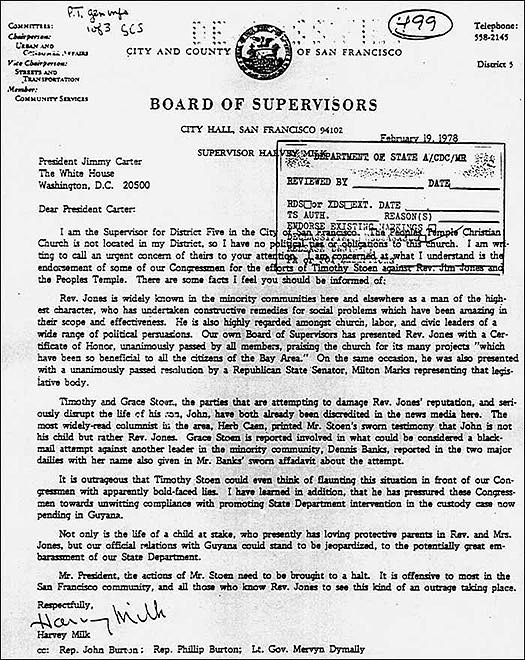
State Assemblyman and future Mayor Willie Brown once praised Jones as an “American Gandhi,” a combination of Martin Luther King Jr., Angela Davis, Albert Einstein, and Mao Zedong (he meant this as a compliment). California Governor Jerry Brown attended a testimonial dinner held in Jones’s honor, and in 1976 the Democratic vice-presidential candidate, Walter Mondale, invited him onto his campaign plane. Nine months before the massacre, the city supervisor Harvey Milk, one of America’s first openly gay politicians, lauded Jones as a “man of the highest character” in a letter to President Jimmy Carter.
* Meant to post this last week, but: Two-time guest Scott Lincicome (#479 & #499) published a crackerjack, eminently book-markable survey on the controversies and countervailing facts about data centers. Nut graf: “[M]ost of the common objections to data centers collapse under scrutiny. The buildings certainly aren’t faultless and raise some real challenges, but they also generate substantial benefits that the backlash conveniently ignores. To the extent data centers really do create problems, moreover, the source is mainly government policy, especially subsidies and energy bottlenecks. And that means better policy can mitigate the real problems surrounding America’s data center buildout—no bans or dire economic consequences needed.”
* Comment of the Week comes from Regina Rodriguez:
Quick note on Amazon Hub Delivery (program where independent contractors can build their own delivery company) - my hubby runs his own (non-delivery) business out of the house but economic conditions have made it so the business is earning maybe half of what it normally would. He looked into the Amazon Hub delivery and let me tell you, it’s been a lifeline. At the start up he decided what days he wanted to deliver, how much and Amazon set him up with all the technology so that its super efficient. He’s getting fresh air, exercise and additional coin, and I get to keep my paid Fifth subscription - Thank you Jeff Bezos.
Sendoff: One of the stock music-biz characters I enjoy most is The Hustler—a guy (almost always male) who maybe starts off as a would-be pop idol, transitions quickly to TV, some promotions here and there, trying to surf out the changes in the industry for as long as he can, and maybe create some indelible moments along the way. So describes Johnny Benjamin de Jong, a.k.a. Johnny Young, a.k.a. a guy you’ve probably never heard of unless you’re Australian, who died this week of pancreatic cancer at the age of 79. The Dutch-born Young was most famous for being the creator/producer/host of Australia’s Young Talent Time show from 1971 to 1988, launching various pop careers. But he got his start as the groovy mid-‘60s front man for Johnny Young and Kompany, scoring a number-one Aussie hit with the double-sided “Step Back” / “Cara-lyn,” covers both. He was also at this time hosting The Go!! Show, which was exactly like it sounds. But the magic really happened when he moved into an apartment with Barry Gibb, who prodded him to write his own damn songs. The results made Australian music history—not for the Kompany, but for acts such as Russell Morris, Ross D. Wyllie, and Ronnie Burns. These songs were less beach-party, more introspective, topical, and psychedelic. For Burns he wrote “Smiley,” a 1969 track about a Vietnam vet. Wyllie (and then later Herman’s Hermits) got “The Star,” one of those self-referential songs about the promise and limits of fame (I try to hack through it here). But it was Morris’s “The Real Thing” that changed time—record-breaking length (6:20!), record-breaking cost, part “Strawberry Fields,” part Manson-inflected Beach Boys; carved firmly into the Aussie rock pantheon:
Michael after make-up and hair always looks like someone who would be hanging out with Eddie Haskell, getting Wally caught up in some hyjinx that would ultimately end up getting the Beav in trouble.
Good read, good clips. Happy Sunday.
Great read! Thank you!