

Before I risk Coleman Hughes’s wrath by kicking more sand in Nikole Hannah-Jones’s eye, some quick reminders about upcoming Fifth Column-related live events, in chronological order:
Oct. 1 I’m on a panel about “The Media and The Midterms: Determining America’s Future,” at the Paley Center for Media in NYC. Oct. 7 is the sold-out-but-waitlistable 10th anniversary live show of The Reason Roundtable in NYC. Oct. 31 I’m on panel about patriotism at the University of Austin. Nov. 6 The Fifth Column will be semi-keynoting at the Foundation for Individual Rights and Expression’s sold-out Soapbox 26 conference in Philly. Nov. 12 we’ll be doing some post-midterms breakdown at Fairfield University in Connecticut. And Nov. 13-14 is the 100% unofficial Dallas Meetup of Fifth Column listeners.

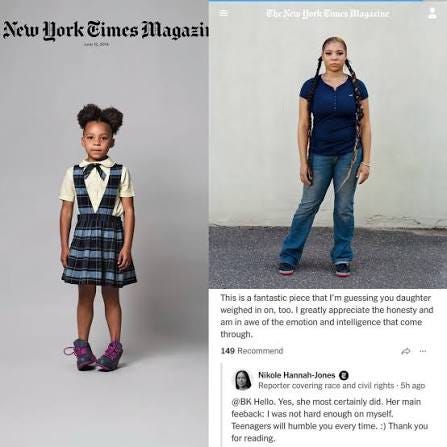
* OK. As discussed in Members Only #346, I was frustrated and occasionally repulsed by Nikole Hannah-Jones’s semi-confessional New York Times Magazine cover story, “In Fighting for Every Black Child, Did I Betray My Own?” In part because of the conceit right there in the headline: She assumed as a given that she was “fighting for every black child,” because that was her intent. Faced with the lived-experience reality of her preferred educational-policy approaches being bad for her black child (and others), she exhibited precious little curiosity about the connection between those preferences and that result. If anything, she clung to her longstanding, sneer-heavy position that those who have disagreed with her methods are doing so out of hostility toward or insufficient regard for the plight of poor minorities.
As Maud Maron, who has long been derided as a pariah by NHJ and an entire swath of the activist educational establishment for her defenses of scholastic rigor in District 2, wrote this week in the Wall Street Journal:
[H]er operating assumption [is] that white parents are to blame for the bad schools in which too many black children are trapped. “This systemic sorting of worthy and unworthy children is justified by saying that our ‘brightest’ students deserve and demand more rigor,” she writes in her most recent article. “While many of the city’s Asian students have benefited from these screens, in reality the screens are part of a tawdry bargain to keep a dwindling number of white and wealthier parents from exiting the public school system.”
My insistence that my children get a good education is neither tawdry nor a bargain. It’s called being a good parent, and Ms. Hannah-Jones could and should have done it for her own child. Now, instead of asking hard questions about why her approach failed, she doubles down on her original thesis: racism.
Ms. Hannah-Jones and I both have children who are juniors in the New York City public schools. I also have two older children who graduated in 2024 and 2026, as well as a fifth-grader, so I have some comparison points Ms. Hannah-Jones lacks. My two eldest graduated from a school system that required Regents exams—subject-matter competency tests that measure students’ baseline proficiency and stress-test whether the system itself is serving students. My youngest two, like Najya, won’t have to take those exams because the “equity” movement Ms. Hannah-Jones champions won the day: The state Education Department has decided that the class of 2027 is the last that will have to pass the Regents to graduate.
I have also seen the effect of replacing state test scores, grades and attendance as admission rubrics for middle school and high school with lottery numbers. It did lessen the number of white and Asian kids in “good” schools and increase black and Hispanic enrollment. It also fueled the exodus of families of all colors from the school system. Ms. Hannah-Jones calls that racism in action. But city data don’t support her claim. The school system asked families why they left. Forty-one percent wanted a more rigorous education than the city’s public schools could provide. Of families who switched to charters, which overwhelmingly serve minority students, 46% cited the need for greater academic rigor. For families moving to private schools, 42% did.
Some similar ed-policy notes here from the always-interesting John Arnold.
Here’s a tale of two articles about the same school system from 2016, in which, again, the headlines contain a tell: First was my Reason colleague Jim Epstein’s “How to Fix ‘One of the Most Segregated Public School Systems In the Nation,’” then NHJ’s “Choosing a School for My Daughter in a Segregated City.” What’s the tell? The protagonist. Epstein (also a Brooklyn parent, though that doesn’t come up), is animated by the admittedly difficult question of how to improve a troubled school system (including a focus on the very elementary school that NHJ sent her kid to). Hannah-Jones, meanwhile, is writing about herself, hoping that her shining example, along with some shaming of those less courageous, can produce a Hero Ball fix to systemic inequality:
I told Faraji that I wanted to enroll Najya in a segregated, low-income school. Faraji’s eyes widened as I explained that if we removed Najya, whose name we chose because it means “liberated” and “free” in Swahili, from the experience of most black and Latino children, we would be part of the problem. Saying my child deserved access to “good” public schools felt like implying that children in “bad” schools deserved the schools they got, too. I understood that so much of school segregation is structural — a result of decades of housing discrimination, of political calculations and the machinations of policy makers, of simple inertia. But I also believed that it is the choices of individual parents that uphold the system, and I was determined not to do what I’d seen so many others do when their values about integration collided with the reality of where to send their own children to school.
Nikole Hannah-Jones has been writing about education policy for going on two decades without ever once grappling seriously in public with the notion that people who advocate for, say, charter schools oftentimes do so precisely because they REJECT the notion that “children in ‘bad’ schools deserved the schools they got.” Here’s Epstein’s doc, which among other things (including a quick NHJ sighting!) discusses the three charter schools within walking distance of the “segregated, low-income school” Hannah-Jones knowingly inflicted on her daughter:
The NHJ-tastic operational method of tarring policy skeptics, including otherwise totally private citizens, with the scarlet letter of racism is what launched me on my path from committed public-school parent to payer of multiple private tuitions. I re-read this week my bewildered September 2019 piece about the aggressively dishonest way that a massive, “equity”-driven admissions overhaul was sold in our trailblazing Brooklyn school district, and it made me furious all over again about the still-lingering decrepit habits of mind and argumentation that led us to this very fallen moment that NHJ’s poor kid is so pissed about. The chronological headlines on some of my relevant pieces since then tell a story of what a system designed by Nikole Hannah-Jones sympathizers looks like in practice:
“Even Social Engineers Don’t Want Their Kids Used as Demographic Pawns”
“Bureaucrats Are Trying to ‘Control’ School Choice”
“N.Y. Schools Chief Richard Carranza Can’t Quit Calling Parents ‘Racist’”
“The Equity Mess: Despite their professed goals, Democrats’ pandemic policies have widened disparities between races, classes, and genders.”
“Families Are Fleeing Government-Run Schools”
“NYC Scrapping Gifted and Talented Program Is a Triumph of Redefining Language”
“Public Schools Experiencing ‘White Flight’”
“How Brooklyn’s Much-Copied Diversity Plan Helped Throw its Best Middle School Into Chaos”
“The People Who Wrecked N.Y. Schools Love Zohran Mamdani”
* I ranted a bit about these topics, plus Trump v. White House reporters & the wilderness era of Fusionism, on this week’s Reason Roundtable:
* Episode #576 with CNN defender-of-Trump Scott Jennings generated some headlines, such as: “‘Do You Stand With CNN?’ Scott Jennings Grilled About Whose Side He’s on in Trump’s Battle With Network” (Mediaite); “Scott Jennings Asked Point-Blank if Trump Has ‘A Corruption Problem’” (Mediaite); “CNN’s Scott Jennings Grilled on Trump’s ‘Corruption Problem’: See His Response” (TV Insider); “Scott Jennings Pauses 5 Seconds When Asked About Donald Trump ‘Corruption’” (RealityTea); “Scott Jennings Hesitates Big-Time When Asked If Trump Has A ‘Corruption Problem’” (HuffPost); and “Job-Hungry Scott Jennings Freezes at Simple Trump Question” (Daily Beast).
For anyone fretting that the above interest was ginned up by the selective editing of social-media clips, here’s a straight-through 8 ½ minute chunk of an otherwise freely available podcast:
* M.O. #346 w/ beloved pal Josh-o Szeps included some clip roulette from the United Nations; note that this was recorded before Benjamin Netanyahu’s beeper callback.
* Kmele’s enTanglement this week was also about the U.N.:
* Moynihan this week donned a tie for his Report interview with legendary NYC gossip Michael Musto:
* How about a nutrient-rich omnigraf of past Fifth Column guests adding to our collective knowledge over the past week? We had talked with David Pakman in M.O. #345 about a deeply dishonest Associated Press presentation about a possible resurgence of lynching. Up steps John McWhorter (veteran of #84, #121, #188 & #366) with a New York Times piece headlined “Are Lynchings Really Happening?” (Betteridge’s Law applies.) We have talked aplenty this year about doomer vs. non-doomer A.I. scenarios; recent guest Steven Pinker (#557) just elaborated on his doomer-skepticism in an open letter to Scott Alexander. Scott Lincicome (#479 & #499) had a fine Washington Post piece on how deeply unpopular Trump’s tariffs have become. And our comrades over at Reflector/Longview/Guys-maybe-pick-a-name have a new miniseries out on homelessness called “Street Fight” that’s well worth your time.
* This date in Fifth Column history: How long ago was our episode of Sept. 27, 2019? Long enough ago that we were talking about Moynihan winning an Emmy award (!), and the possibilities of Donald Trump being impeached. But also, not-long ago enough that we were disputing the notion that Cancel Culture was a “myth” while making fun of Greta Thunberg!
As for our individual pursuits on that date, in 2010, Moynihan wrote a piece on “The Execrable Alan Grayson,” in 2013, I appeared on HBO’s Real Time with Bill Maher; and in 2021, Kmele was … at a conference?
* Time for Producer Jason’s Video Vault!
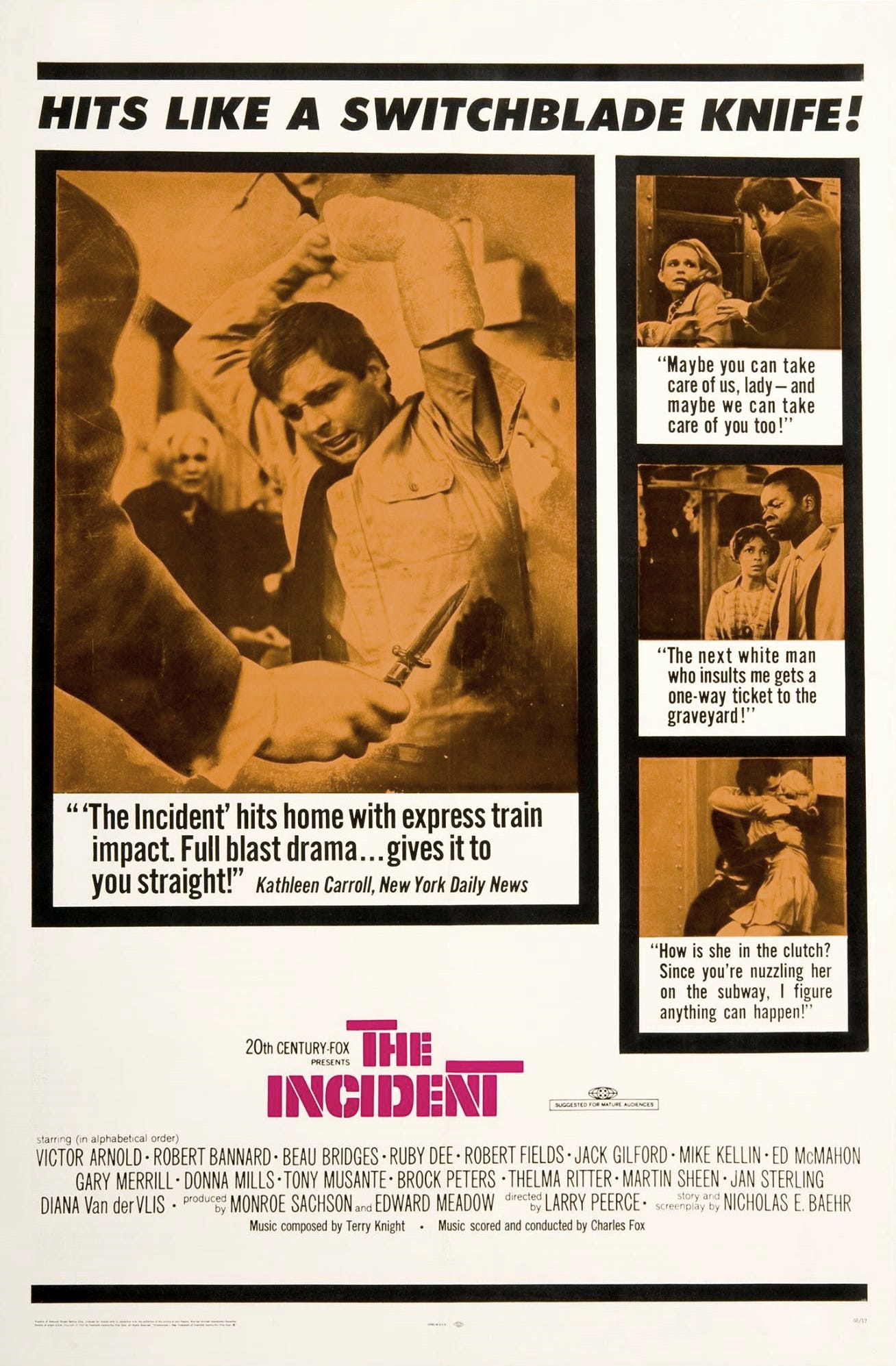
Prompted by Moynihan recounting yet another tale of woe from the rolling sanitarium that is the New York City subway, this week we’re rewatching The Incident: a claustrophobic, pressure cooker of film that reminds us that riding the MTA has been a gamble since at least 1967. Martin Sheen makes his big screen debut as one of a pair of drunken hoods who stumble onto a train car and begin harassing people while the other passengers look the other way. The legend of Kitty Genovese looms large over this drama, but the twist here is that the bystanders’ failure to intervene on behalf of a fellow passenger just means that they’re lined up to be the next victims of intensifying hostilities as the hoods eventually take the entire car hostage. It’s like The Taking of the Pelham One Two Three meets Funny Games, with Ed McMahon and a baby-faced Beau Bridges. Hang on tight for an infuriating ride that will likely bear some resemblance to your own commuting experience (unless you live in Tucker Carlson’s Moscow). Watch free (with ads) on YouTube; buy the Blu-ray; here’s the trailer:
* Comment of the Week goes to MacKenzie Madison Murphy:
“That’s a very generic question” will now be my response to very specific questions.
Sendoff: I will go on record as absolutely despising that little moment they do in every World Series where they stop one game and everyone holds up a sign about how much they want to beat cancer. Please note that I do not say this because the Angels lost their 100th game on the last day of the season today, thus becoming the final MLB franchise to hit that inglorious mark, nor do I say that because I’ve got some weird hard-on for cancer. Let the record state that I actually rather despise cancer, that I also despise compulsory group-signaling interruptions, and that if I were in that gun-to-the-head position I’d hold up the gnarliest looking sign that said “FUCK CANCER!!!” preferably designed by my old friend COOP. I was already thinking about such things this week when looking for a recently deceased musical artist to include in this week’s Sendoff, and alighting upon the obviously energetic and productive pop-punk guitarist, singer, and producer Chad Gilbert, who spent one-third of his far-too-short 45 years just rage-battling the C-word into what was usually a draw. The fuckers took out a dad and productive artist in what should have been the prime of his life. I did not know his band New Found Glory, but they were alarmingly huge, and you will immediately recognize the sound of plaintive early-aughts sugar-punk on songs like “My Friends Over You.” Here’s Gilbert singing lead in New Found Glory’s side project, the International Heroes of Hardcore. RIP, punk dude.
“Beloved Fif’ listener Book of Trees, a.k.a. Maya Sulkin”
Book of Trees is not Maya Sulkin.
I will repeat my description (from Smoke Em) of the despicable NHJ as a self indulgent professional race baiter. Not to mention that she is an attention whore. I don't trust the veracity or motives of anything she writes.