


Mad props not just to Ilya Somin for writing the blog post then helping bring the case that struck down monarchical tariffing, but also to Michael Moynihan for being a one-man hosting band during a busy news week when some of us were just too busy doing important work (see above).
But now, because relief is fleeting and the struggle eternal, not only does Congress and its bosses have to do something with all this re-realized freedom & responsibility, more importantly, *I* have to cope with arriving after a seven-day Bahamian gambol at precisely the moment when a once-in-a-decade blizzard dumps fresh new hell on the high-tax haven that for some faded reason I call home. Further bee-ing up my bonnet is that said arrival coincides dangerously close to the gold medal Canada-U.S. puck-drop, which some direct blood descendent of Mussolini apparently thought fine to schedule at 8:10 AM ET. Bastardo.
So: Savor your victories, enjoy your sandwiches, but get right the hell back to work, is what I’m saying. (And by “work,” I do mean “cursing creatively at Canadians.”)
* God help us all, but there’s going to be a State of the Union Address Tuesday night. My name is not Bill Maher, and I fully endorse this message:
* Some of Maher’s references here are pulled straight out of another book that Moynihan has mentioned several times recently, Gene Healy’s 2008 The Cult of the Presidency: America’s Dangerous Devotion to Executive Power. I was proud to put an edited excerpt on one of my first Reason covers; here’s a Founderstastic section:
Early presidents rarely spoke directly to the public; from George Washington through Andrew Jackson, they averaged little more than three speeches per year, with those mostly confined to ceremonial addresses. In his first year in office, by comparison, President Clinton delivered 600.
In the early State of the Union addresses to Congress, presidents knew better than to adopt an imperious tone. After his third SOTU, Washington wrote that “motives of delicacy” had deterred him from “introducing any topic which relates to legislative matters, lest it should be suspected that [I] wished to influence the question” before Congress. Yet the deference shown by Washington and his successor John Adams didn’t go quite far enough for our third president, Thomas Jefferson, who thought their practice of speaking before the legislature in person smacked of the British king’s “Speech From the Throne.” Jefferson instead inaugurated a new tradition of delivering the annual message in writing. For 112 years, that Jeffersonian tradition held sway, until the power-hungry Woodrow Wilson delivered his first State of the Union in person.
Healy’s conclusion, with a faint whiff of pre-emptive Gorsuchea, pins the ultimate onus on the people who killed the Kennedys:
Today’s “presidentialists of all parties” – a phrase that describes the overwhelming majority of American voters – suffer from a similar delusion. Our system, with its unhealthy, unconstitutional concentration of power, feeds on the atavistic tendency to see the chief magistrate as our national father or mother, responsible for our economic well-being, our physical safety, and even our sense of belonging. Re-limiting the presidency depends on freeing ourselves from a mindset one century in the making. One hopes that it won’t take another Watergate and Vietnam for us to break loose from the spellbinding cult of the presidency.
* Knife-wielding Justice Neil Gorsuch (subject of another old Reason cover, “But Gorsuch!”), made many a self-government (and divided-powers) enthusiast’s knees go wobbly with his score-settling concurrence, as you could hear in Moynihan’s quick-draw One-Hitter Friday with the ever reliable Damon Root (veteran of episodes #45, #106, #206, Members Only #117, #363, #413, and #462). Damon expounded on that a bit more in writing Friday; Somin penned a victory lap for The Atlantic, and obviously our tariff-nerdbot pal Scott Lincicome (#479 & #499) was quick on the draw for the Wall Street Journal.
But maybe the best explainer was a pre-explainer, from why-haven’t-you-had-her-on-the-podcast-yet legal beagle Sarah Isgur, in The New York Times last December. Under the headline, “Actually, the Supreme Court Has a Plan,” Isgur drew a plausible-sounding sketch of a Supreme Court trying to rein in the power of the bloated independent administrative state by giving the president more leeway (via unitary executive theory) over what in fact is supposed to be part of the executive branch, while simultaneously (via the major questions doctrine) attaching some electrodes to Congress’s balls (my word, not hers). In other words, “Give the president more control over a weaker presidency.” Isgur did an emergency Advisory Opinions podcast with David French (#191, #325, #365) on Friday.
Also worth noting is the extended disreputable tantrum thrown by the president of the United States. Tuesday’s gonna be lit!
* Time for Producer Jason’s Video Vault!
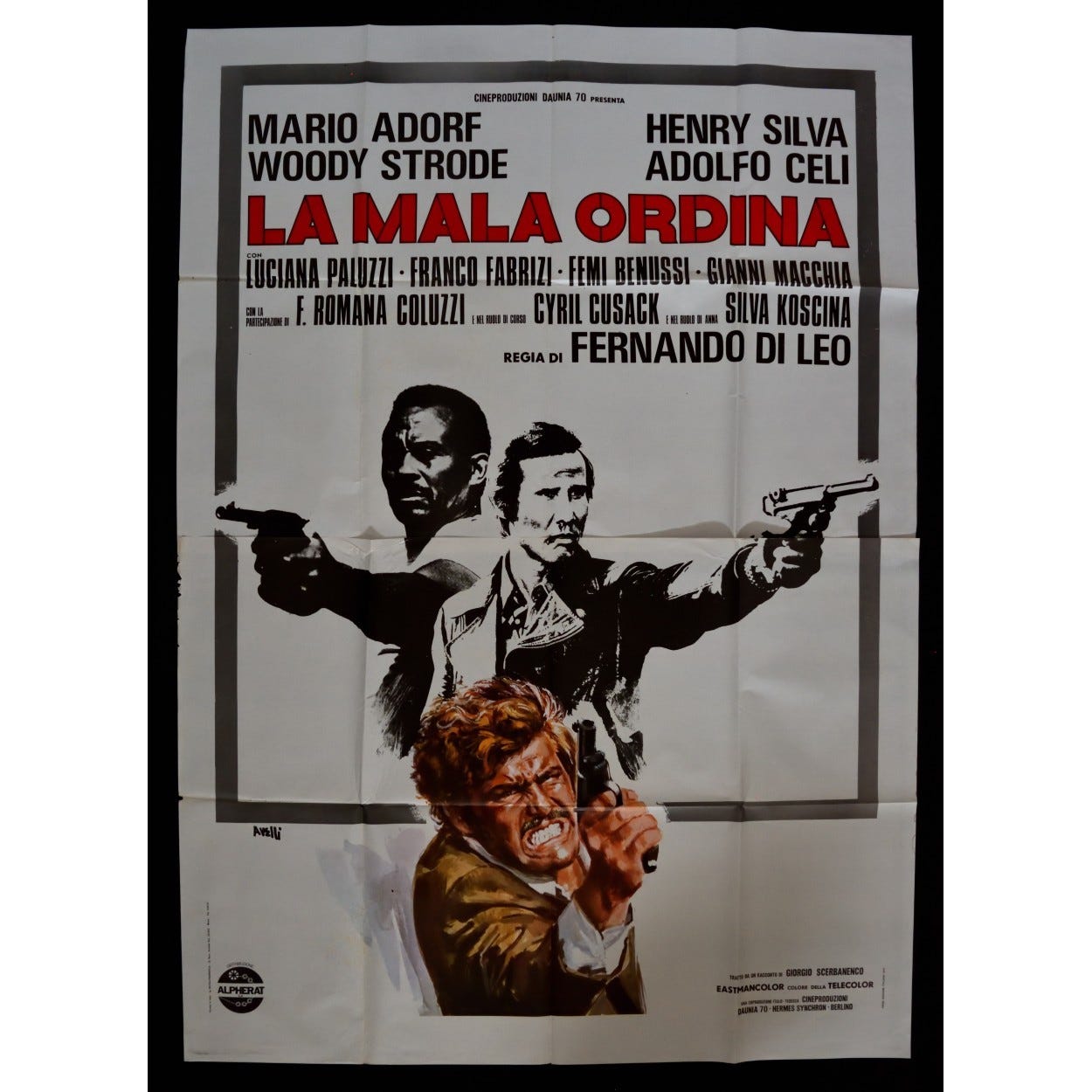
One of my favorite genres of film is one that I call “Find Him and Kill Him.” Classic examples include Get Carter (1971), Point Blank (1967), and Man on Fire (2004). But the film that kicked off my love for these vengeful procedurals is Fernando Di Leo’s La Mala Ordina (1972). I first came across a beat-up VHS copy of it under the title Hitmen, but it is perhaps best known in the U.S. as The Italian Connection – presumably an attempt to ride William Friedkin’s coattails.
This is not a subtle movie. The premise is clear from the very first line: “The man you’ve got to kill is Luca Canali.” The men on the receiving end of these instructions are played by Henry Silva and Woody Strode, taking their turns as fading Hollywood actors brought onto an Italian production to increase their international salability. The real star, however, is hard-to-kill Mario Adorf, who delivers a visceral and shockingly physical performance as a small-time hustler turned stone-cold psycho after his wife and daughter are killed. Was that a spoiler? Not really! What’s also not important is why they want to kill Luca Canali (stole some of the mob’s drugs or something). What matters is you get lots of Mario Adorf slapping people around and a totally over-the-top chase scene that is worth the price of admission (which is, on some platforms, free). Sure, it lacks some of the moodiness of the other films in Di Leo’s so-called “malaise trilogy” (Milano Calibre 9, and Il Boss), but it’s a hell of a lot more fun. Original U.S. Trailer:
* Comment of the Week comes from Chris L:
Strangely enough, I was reading his book the day of the Maduro capture and was on the chapter where he’s critical of Rubio’s viewpoint of Venezuela. If I recall, his premise was that Rubio’s hawkish view is wrong because the Chavismo government is far more popular than it appears (which he argues with Moynihan a bit about). Will be interesting to see how things play out.
It is a very good book, and I would recommend to anyone that can separate reporting (fact) from opinion. He tries to be “middle-of-the-road”, but in doing so, ignores so many of the ills of socialism. The chapter that irked me the most was when he describes the recent (2019-20ish) decaying state regime as basically a libertarian wet-dream because of the minimalist/underfunded government services, without pointing out that the reason for that is the state ran out of money because it strangled the private economy.
He’s also very careful in the book not to fully describe what brought down the Venezuelan economy as “socialism”. While the country might not have taken the traditional Marxist “seize all means of production” route, acquiring (either through purchase or expropriation) key industries in order to provide social programs to the poor and over-regulating the private economy with heavy price/currency controls appears to be the modern socialists’ strategy. Call it whatever you’d like, but it’s pulling from the same grab-bag of failed collectivist policies.
Good reporter. Bad politics.
I finally got copy of The Silence and the Scorpion and am looking forward to reading.

Rushing to get this Firehose out the door while this boat’s wretched WiFi still works. So! Apologies for the shortness, back to work right away, and….
Sendoff is a song that sounds SOOO familiar, yet you (like me until five minutes ago) had never heard this, the original version of a Linda Ronstadt New Wave single, and even if you’re not conversant with the latter, the song STILL seems familiar, because it sounds like it was a designed in a factory called THE EIGHTIES, by a guy who tried to make it as a recording artist called Billy Thermal, but then settled for the lowly life of a ridiculously successful ‘80s hit songwriter: “Like a Virgin,” “True Colors,” “Eternal Flame,” “I Drove All Night,” “I Touch Myself,” etc. ad infinitum. RIP to a Fresno-Palm Springs-Carpinteria-Bard real one, Mr. Billy Steinberg:
Matt! Well deserved vacation. Hope you are willing/able to share some people free photos in general chat! ❤️
Thanks again for putting this together, especially right after coming back from a week of family time.
Michael did a great job on his own, even if there were listeners complaining about the guests or him not pressing a question to their liking. Makes me remember the saying that rings true “A Marine isn’t happy if they aren’t bitching about something.” He must be doing something right!
Thanks for everything fellas! ❤️
If y'all can get Sarah Isgur on here that'd be a great crossover podcast I'd love to listen to (and watch). My top podcast is The Fifth Column, and quickly followed by Advisory Opinions and Blocked & Reported.