

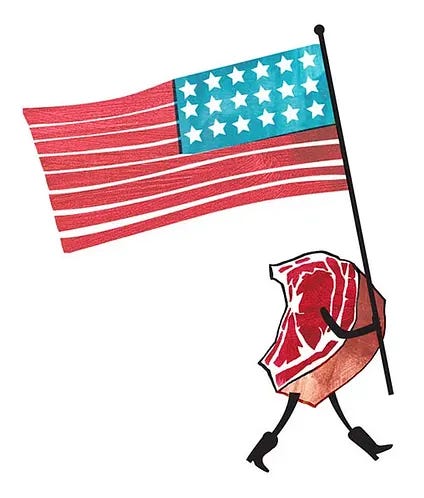
The vibes, they are indeed elite. My view from Dimes Square last night:
Since 99% of you reading this email were not on our monthly Second Sunday Zoom call with paying subscribers, I can testify that 1) you’re missing out on a lot of cute babies!, and 2) we spilled the kind of not-for-publication tea (in direct response to listener queries) that would give you more context before mashing that “send” button on the latest complaint and/or elaborate theory about our motivations for trying out new things on a 10-year-old podcast. Not dissimilar to how actually listening to an episode makes your criticism of it smarter! Anyway, the main thing is that it was a real fine time, and remains a solid reason for upgrading from free.
* Speaking of Ana Navarro, here’s a clip from the rip-roaring Members Only #327, during which we unsuccessfully lobby the erstwhile Republican to get back in touch with her former friend Marco Rubio:
* As referenced on the aforementioned Zoom call, as well as on Episode #561, one of the surprise contributors to Good Vibes Summer has been the influx of World Cup visitors from Euro-land posting ridiculously wholesome content about the awesomeness of American football stadiums, Waffle Houses, ice dispensers, school buses, Irish cops, and junk food. The German soccer fan Freddy has so charmed us with appreciative flattery that he’s being gifted concert tickets by Ella Langley and swank hotel rooms from J.J. Watt. Scots in Boston are singing “Country Roads”; Lawrence, Kansas, has straight-up adopted Algeria. Time for a think-piece, Ethan Strauss!
There’s so much negativity out there in high culture about our nation, from our own elites and elites abroad. We’re at a current low point in Gallup’s “Are You Proud to be an American?” question, with much of the decline driven by liberals during this Trump era. That makes some sense, but let’s take a 30,000-foot view of that historic bottom:
A record-low 58% of U.S. adults say they are “extremely” (41%) or “very” (17%) proud to be an American, down nine percentage points from last year and five points below the prior low from 2020.
This means that a solid majority of Americans are still “extremely” or “very” proud to be an American. Where in the national news can they find feel-good stories that channel this sentiment? If you’re looking for smaller anecdotes, it’s not especially novel to see Murica-love voiced by a flag-waving Texan. It’s more fun to witness such positivity from the vantage of a cosplaying World Cup Brit.
In conclusion, yes, there might be an aspect of contrivance to the current praise of our country from this influx of visitors. There’s also a real, mostly unmet yearning for that kind of admiration. Perhaps Buc-ee’s isn’t really the best we have to offer. But our country offers a whole lot to a great many, and there’s something glorious about the size and color of the American mundane.
* Taking the more sourpussy route (as also reffed on 2nd Sun) was the legion of lefties and elected Dems who reacted to the world-beating initial public offering of SpaceX not with appreciation for having a globally envied capital markets system that both gooses and rewards insane experiments in innovation, but rather with economically illiterate, historically fantastical, punitive and confiscatory lust. With the caveat that social media was a mistake, the single best online source for swatting away at the nonsense has been the guest on our seventh-ever episode, National Review’s Charles C.W. Cooke.
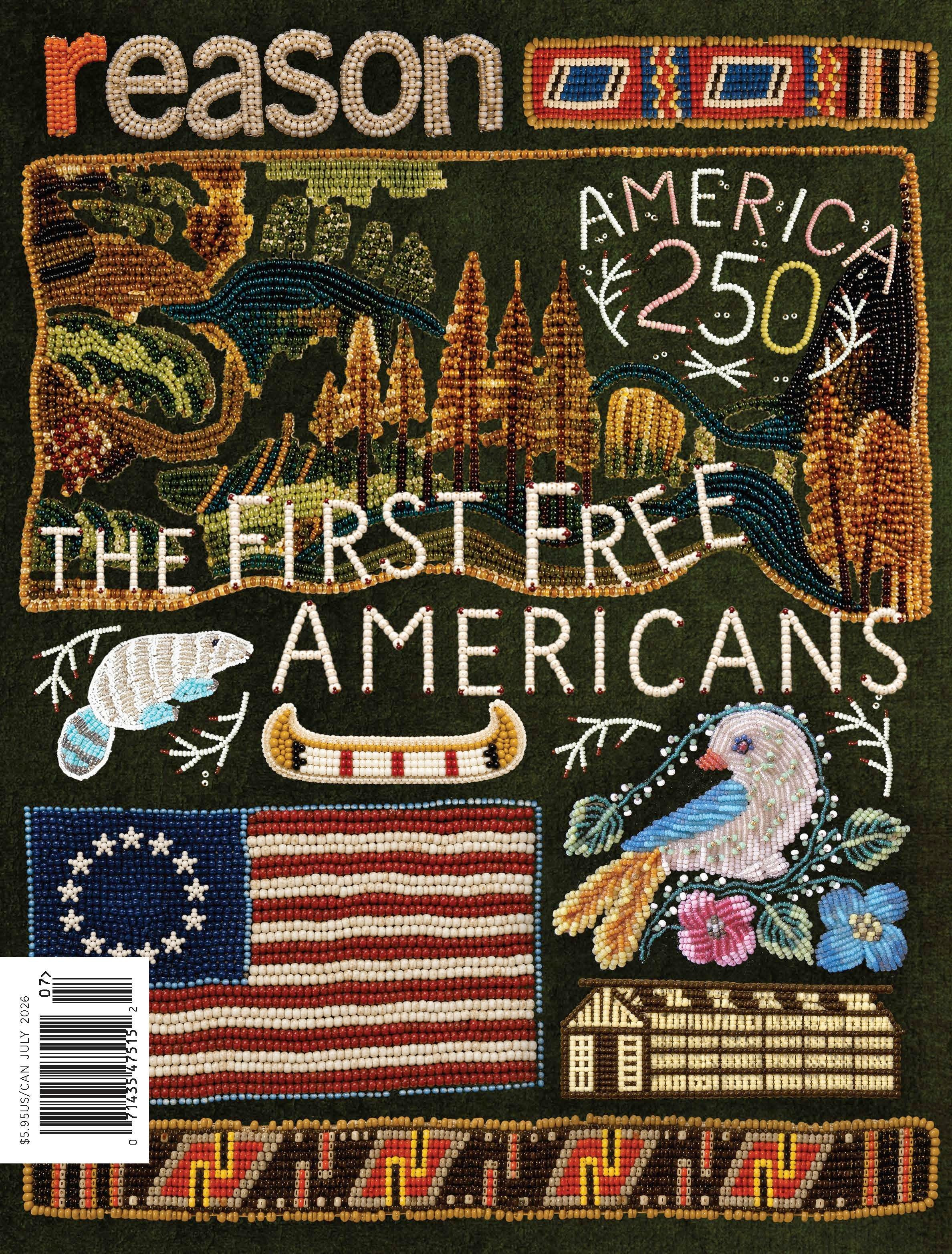
* Those of you who enjoyed The Revolutionaries miniseries-within-the-pod will have a great time with the July issue of Reason, illustrated by the same insane gal who brought you the flag-meat-boots image at the top of this post, Swedish-born American patriot and Moynihan-ex Joanna Andreasson. This past week two pieces of note from that special edition were published; the first by past Revolutionaries guest Charles C. Mann, about how “the mental landscape of the Revolution, from its originating conflicts to its military tactics to the Founders’ ideas about freedom and the role of government, was also shaped by the continent’s original inhabitants.” Many interesting passages! Here’s one:
The first European ventures into North America occurred as Enlightenment figures such as John Locke, Jean-Jacques Rousseau, and Voltaire were questioning Europe’s absolute monarchies, state religions, and rigid class rules. All of these thinkers were fascinated by the recently revealed existence of Native Americans—living, breathing products of societies with wholly different social, political, and spiritual traditions. All of them made Indians central to their work.
None of these thinkers were ethnographers in the modern sense. The “natives” featured in their work mainly are foils—convenient human illustrations for ideas. […]
At the same time, other Europeans actually were interested in native life—and drew lessons from it. Again and again, foreign visitors to New England and Quebec described their inhabitants as having vastly more personal liberty and autonomy than Europeans. “They imagine that they ought by right of birth, to enjoy the liberty of wild ass colts, rendering no homage to anyone whatsoever,” wrote Paul Le Jeune, a Jesuit missionary in France’s Canadian colony from 1632 to 1649. “They have reproached me a hundred times because we fear our Captains [nobles and kings], while they laugh at and make sport of theirs.”
Unlike Locke, Rousseau, and Voltaire, Le Jeune had a conception of native life that was basically accurate. As he reported, native rulers had little formal authority; they had to persuade others to follow their ideas. The Haudenosaunee, for example, have a tadadaho, who presides over the Grand Council, which itself was comprised of male leaders of the league’s six member nations. Tadadaho is traditionally a lifetime appointment, like a king, but the role is more like today’s speaker of the House—someone who shapes the agenda but must marshal the support of the other representatives to make anything happen. Even if the tadadaho won the Grand Council’s backing, he could not act without the approval of a second, all-female council, traditionally formed of clan mothers.
Unlike European kings and nobles, Haudenosaunee leaders could be deposed if their people lost faith in them (although this was relatively uncommon). They had to have the consent of the governed and worked hard to keep it. Were the colonists who rebelled against King George and established a republic inspired by this? Surely not directly. But it seems clear that the colonists on the Atlantic seaboard were imbued with views about freedom that were strikingly different from those of their ancestors, and that they identified those views with native people.
The second piece of possible interest came from me—”Disillusioned Revolutionaries: Many Founders Died in Despair About the American Experiment.” Here’s a chunk from the intro; make sure to read all the way to the 1970 Beatles comparison at the end!
Founder disgruntlement was the rule, not the exception (and the exception to that rule was James Madison). “Those of them who lived on into the early decades of the nineteenth century expressed anxiety over what they had wrought,” wrote the historian Gordon Wood in The Radicalism of the American Revolution. “Although they tried to put as good a face as they could on what had happened, they were bewildered, uneasy, and in many cases deeply disillusioned.”
Added the historian Dennis C. Rasmussen in Fears of a Setting Sun, about the only book-length treatment of the subject: “Most of the other leading founders—including figures such as Samuel Adams, Elbridge Gerry, Patrick Henry, John Jay, John Marshall, George Mason, James Monroe, Gouverneur Morris, Thomas Paine, and Benjamin Rush—fell in the same camp.”
Some of the sources of their souring were one-offs: 18th century conditions that could not be replicated now, such as Napoleon marching through Europe, or just the concentrated creativity of the Founding itself. Others, though, resonate with the political anxieties of today.
* The aforementioned Charles Mann and long-ago Fifth guest Virginia Postrel have a brand new podcast, called Everyday Abundance, that “explores the hidden histories behind everyday activities and the technologies we don’t even know are technologies.” On of their first episodes is on … brushing your teeth.
* Let’s get some more video. Here’s Kmele & the Tanglers talking about A.I., and “one of the biggest challenges facing modern democracy: misinformation.”
* From Monday’s Reason Roundtable, here’s an edited clip of me shitting on California voters:
* And just because I’ve been meaning to watch the whole thing, here’s the the long-awaited completion ceremony for Sagrada Familia, featuring the very greatest of all American Popes:
* Over at The Dispatch, our business partner Jonathan Farber (sometimes referred to on the podcast as “Fucking Jonathan”) wrote up a fascinating new study he helped bring to life about political bias in academia:
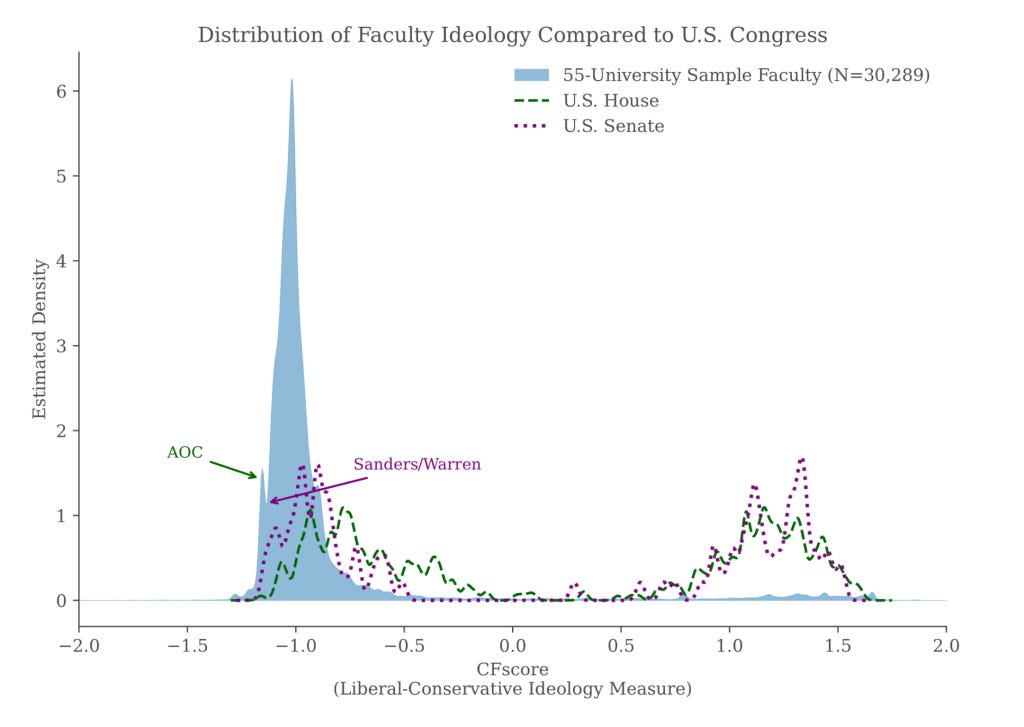
The typical politically active professor teaching at Harvard, Yale, Georgetown, and America’s other leading universities sits in the same ideological neighborhood as Bernie Sanders, Elizabeth Warren, and Alexandria Ocasio-Cortez, the three most progressive members of Congress. The bigger issue, however, is that many campuses lack the intellectual range for anyone to seriously challenge those professors’ views. That is the central finding of a new study commissioned by the Foundation for Individual Rights and Expression (FIRE) and conducted by University of Rochester political scientist David Primo. […]
Primo’s study adds that new dimension to our understanding of faculty ideological diversity. It draws on a database built by Stanford political scientist Adam Bonica that tracks more than 850 million political contributions since 1979 and places every donor (and every politician they fund) on a single continuous left-right scale. Donors to Susan Collins occupy a different ideological position than donors to Ted Cruz, even though both give only to Republicans. The same logic separates Manchin from Warren donors. The result is a number on the same scale used for every member of Congress, placing faculty directly alongside the people who write America’s laws. […]
The national political discourse has widened over the last 30 years, while the university’s ideological makeup has instead bunched dramatically in this single highly progressive spot on the spectrum.
* Time for Producer Jason’s Video Vault!
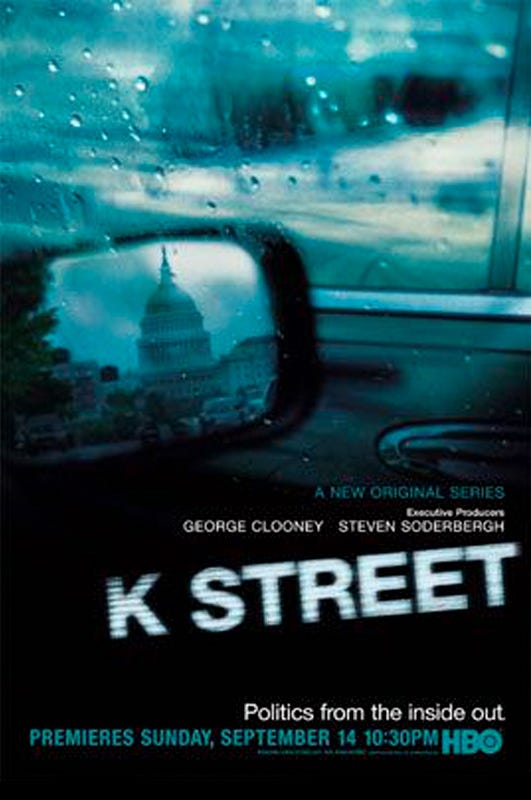
In the first few minutes of this month’s Second Sunday, while waiting for Kmele and Michael to join, Matt and I somehow got on the topic of Bob Roberts, which led to Tanner ‘88, which led to my favorite political mini-series: K Street. Directed by Steven Soderbergh, it’s an ambitious, experimental 10-episode series starring James Carville and Mary Matalin as themselves, playing in largely improvised scenes against Jon Slattery (Mad Men), Roger Guenveur Smith (Malcolm X), and Mary McCormack (The West Wing), with the mysterious “Bergstrom” played by Elliott Gould manipulating them all from New York. Is that anti-Semetic? A little! The production team shot each episode on handheld video cameras over a three-day period and then had just two days in edit before handing them over to HBO for air that week, then doing it all over again. I once ran into Soderbergh and mentioned how much I loved the show, to which he said, “You are the second person who has ever said that to me,” before recounting what a grind it was to make, and vowing to never do something on that schedule again. But what they made was a super weird, voyeuristic, highly compelling, conspiratorial, hot mess that’s worth the watch. Keep your eyes out for cameos from Howard Dean, Paul Begala, Orrin Hatch, Bill Kristol, Tucker Carlson, Chuck Grassley, Donna Brazile (“it’s still Chocolate City, despite all these vanillas that keep dropping in”), and … Howard Kurtz. Get the DVD; watch for free on YouTube; here’s the (terrible, George Clooney-heavy) trailer:
* Comment of the Week comes from Gordon Bombay:
Chris Murphy is like if not having a sense of proportion were a person
Sendoff: I am the first to confess I wasn’t familiar with the stylings of the visionary if vision-less James Blood Ulmer, the experimental guitarist who died June 3 at the age of 86. But that’s why I love familiarizing myself with & trying to honor the recently deceased! Imagine if Camper Van Beethoven was a mostly instrumental, kinda jazz-punk-blues percussive and stabby thing, complete with violin…. Clash put it like this: “His music was tagged free funk, and his skills termed as harmolodics, but in truth he was a complete one-off.” Sure! Dude played with Art Blakey, Ornette Coleman (who he reminds me of most), and then just made dozens of records. I have spent most of this afternoon with his new-to-me stuff on shuffle, and greatly enjoyed it. As for my pick of song? It’s also his most popular, I swear:
Gotta stop doing second sundays while I’m at church
That Primo study commissioned by FIRE is absolutely nuts. And yet there are people who still deny faculty bias, or (perhaps more infuriatingly) suggest that it's the result of a "tRuTh BiAs".
Just to add that I logged into my lurker Twitter account just to read some of Charlie Cooke's replies, and... well, let me just say he has the patience of a saint to even bother. Engaging with relentless and willful stupidity must be like trying to swim up a waterfall. That kind of ignorance is why I have mostly checked out of social media. Fuck that noise. The number of times I've posted some variant of "Musk couldn't get anywhere near $1T in cash: it's all bound up in the value of the companies he runs and reflects his willingness to continue doing so" to a chorus of socialists howling like baboons and demonstrating zero curiosity about how the world got all that great tech they enjoy pales in comparison to Cooke's Sisyphean efforts, and yet even *I* am tired of it.