


Happy late Sunday from beautiful springtime Portland, where the local news is all about such metropolis-on-the-grow stories as madmen driving splodey-cars into downtown buildings, retail giants closing down, and -- this may come as a shock -- May Day protesters hucking shit at cops & the local ICE building. All of which is an excellent reason to turn off the local news, and instead traipse around the green fields and splash in any of the roughly 1,000 local rivers. That grass ain’t gonna touch itself!
* With all the incessant talk these past six or so months about increasingly conspiratorial right-of-center commentators/podcasters, there has been a notable hole in chat when it comes to a 21st century O.G. of the form, Glenn Beck. So what’s Beck doing these days? Well, talking to Kmele! Here’s a video clip:
Blasto from El Pasto: Moynihan doing a Vice News segment on Beck for HBO!
* Kmele also went on CNN Tuesday with host Abby Phillip (guest on Episode #532) and co-panelist Lydia Moynihan (#533), talking about the Trump administration’s godawful week on speech:
* Foundation of Individual Rights and Expression (FIRE) chieftain Greg Lukianoff (#216, Members Only #183, #427, M.O. #276) headlined said godawfulness thusly: “Kimmel and Comey: If it Looks Like an Attempt to Chill Speech by Trump, it Probably Is: A painfully long list of previous examples of Trumpworld flexing its muscle against clearly protected speech.”
* Speaking of FIRE….
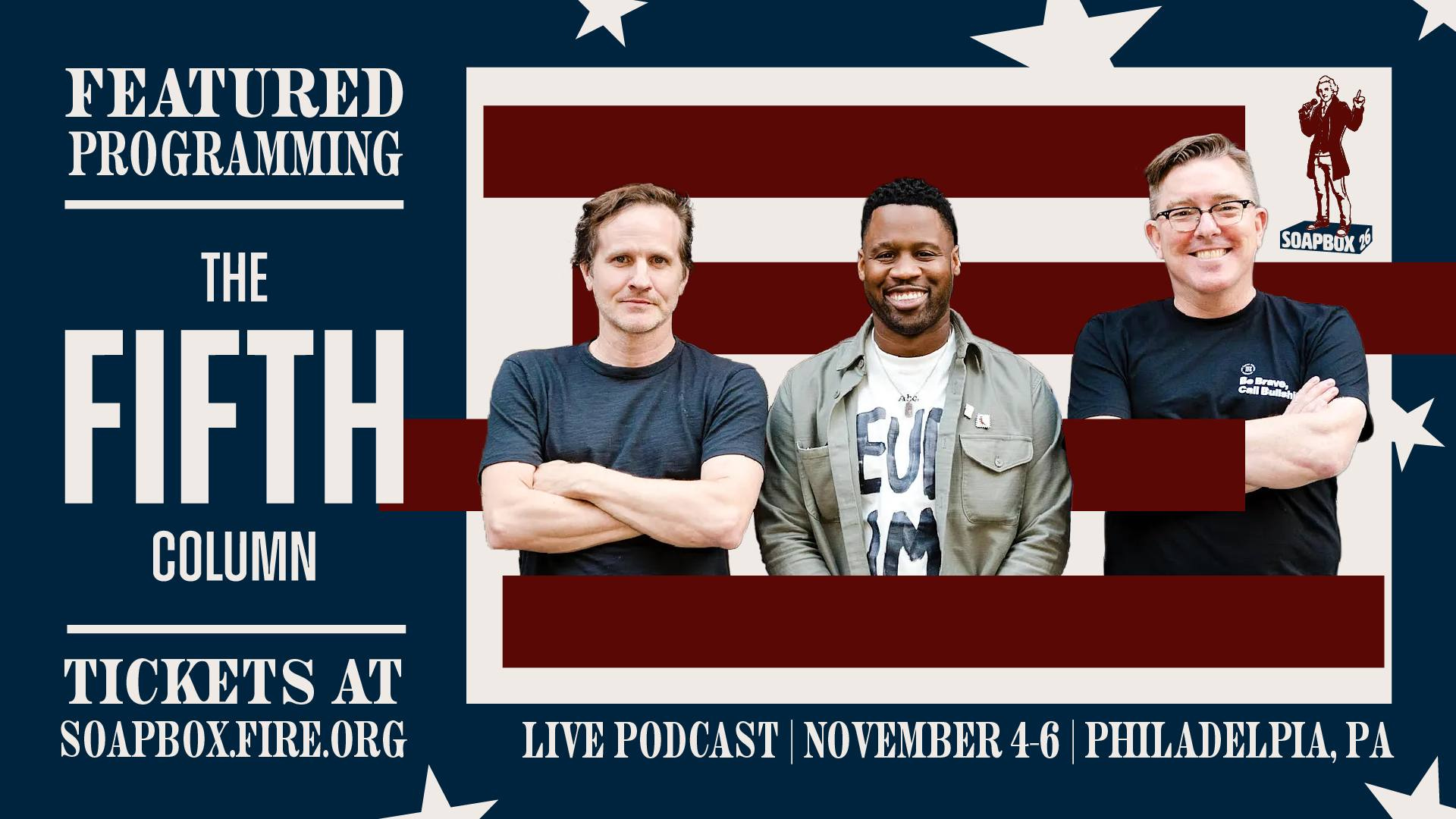
Go to https://soapbox.fire.org/ and use the discount code FIFTH to save $50 on tickets to FIRE’s Nov. 4-6 Soapbox conference in Philly, at which we’ll be podcasting live and hanging w/ pals like Nick Gillespie (Special Dispatch #72, #379, M.O. #251), Jacob Mchangama (#102 & #344), John McWhorter (#84, #121, #188 & #366), and Matt Taibbi (#226, #348).
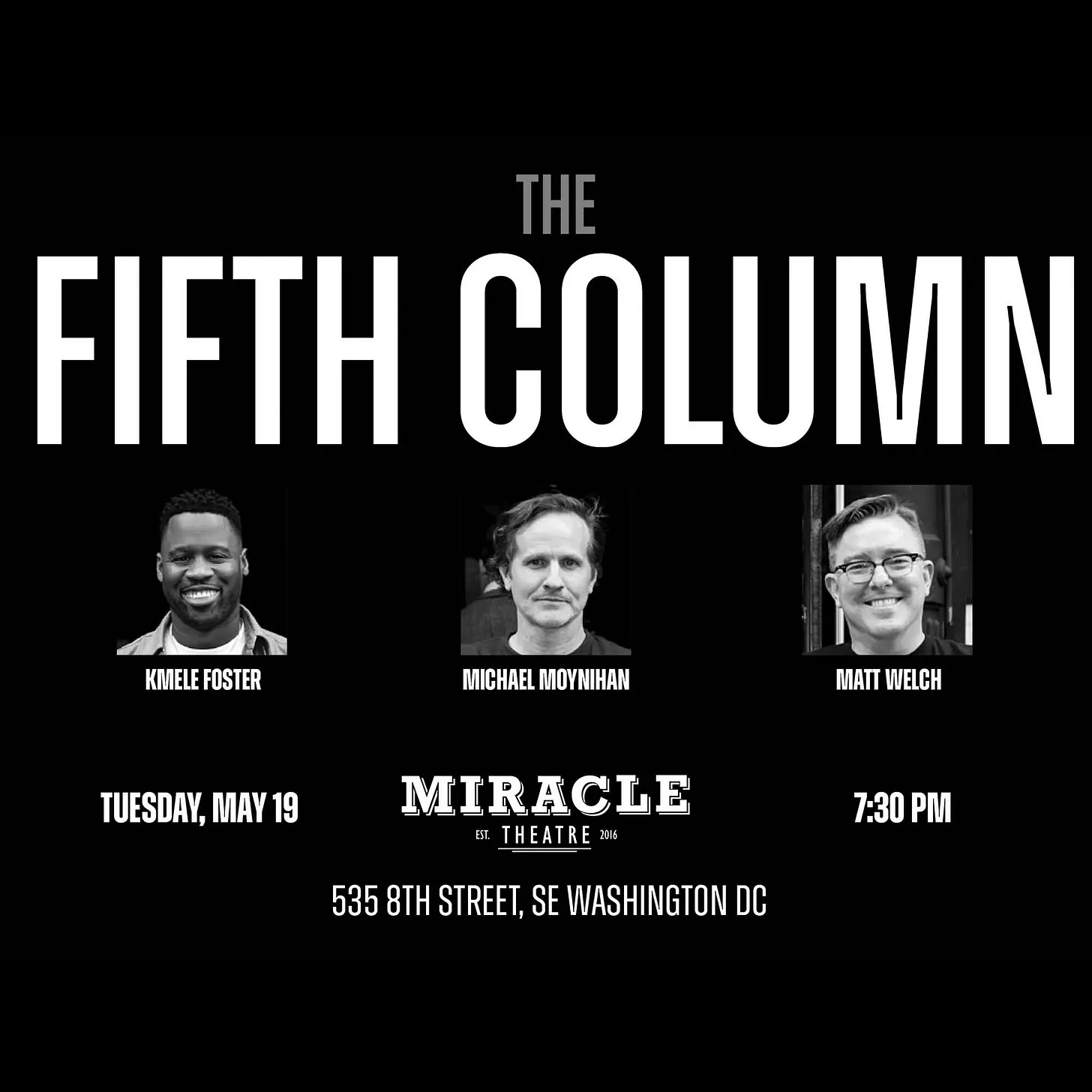
Also, let’s not forget May 19 in D.C.…
* #555, turns out, was actually David French’s fourth time on the Fifth. In June 2020, he talked to us about “American Racism, SCOTUS Stuff, Qualified Immunity” (sound a bit familiar?). August 2021 was a one-on-one w/ Kmele on “Systemic Racism, Earnest Disagreement, About Those CRT Bans,” and July 2022 brought “People with Capacities, Roe Reconsidered, Malignant Forces.”
French this year was nonplussed by Louisiana v. Callais, which narrowed the reach of the Voting Rights Act. Here he is expanding more on that theme w/ our recent guest Sarah Isgur:
I for one identify more with the analysis of George Will:
Last week, the court held, 6-3, that henceforth its gerrymander jurisprudence will accommodate the obvious: The VRA long ago accomplished its 1965 purpose, the abolition of government measures (e.g., poll taxes and specious “literacy tests”) intended to impede minority voting.
[Barack] Obama’s words … illustrate the semantic slipperiness of progressives who value the VRA not as it was written and intended, but as it was perverted — inverted, actually — in subsequent decades by Congress and the Supreme Court. The VRA was written to enforce the 15th Amendment’s guarantee of minorities’ access to ballots. It banned practices that, on the basis of race, abridge any individual’s participation in voting. The 1965 VRA neither affirmed nor even intimated a “right” of particular groups to particular electoral outcomes.
Decades later, the VRA was amended by Congress, and construed by excessively deferential courts, to guarantee certain favored minorities a political entitlement: the right to elect candidates of their “choice.” The law came to presume (and thereby encourage) groupthink: Government-stereotyped minorities are and should be politically homogenous in their choices.
The VRA became a guarantee against “vote dilution,” a phrase that appears nowhere in the 1965 act. The phrase denotes what supposedly occurs when congressional redistricting reduces the likelihood of minorities electing minority representatives. Last week, the court said that henceforth racial gerrymandering will be presumptively unconstitutional unless targeted to remedy specific instances of discrimination.
* Since both David French and Sarah Isgur do work for The Dispatch, that’s segue enough for … AD SWAP!!! (ad swap ad swap….)
The Dispatch: Journalism Without the Circus
The internet rewards the loudest take. We reward the most honest one. If you’re tired of outrage dressed up as analysis, join The Dispatch.
Jonah Goldberg and Steve Hayes launched TheDispatch in 2019 because serious journalism was drowning in partisan noise. No clickbait outrage, no team-sport punditry, no hot takes masquerading as reporting—just rigorous analysis and honest commentary that treats you like an adult.
Join half a million readers who’ve already found a better way to stay informed.
Firehose Readers: Try The Dispatch for 7 days for $1.
***
* We over-index for music & musical arguments around these parts. (If you’re a relative newcomer, check out “Fifdom’s Fave Four-Album Runs,” “Steve Albini on Music, Meaning, and the Cosmos,” “The Five-Worst-Songs Challenge,” “We’re All Brian Wilson Now,” and “Wait, Is This a Pop Culture Podcast?”) So, even though it’s bait, I am squeezing it onto our hook—here is The New York Times Magazine’s list of “The 30 Greatest Living American Songwriters.”
Who’s your biggest snub? Some (not named Michael Moynihan) might say Billy Joel. Others (almost definitely named Michael Moynihan) would say Paul Westerberg. My gut would suggest Jeff Tweedy (who has a great Substack), but my record collection indicates a second meaning for this Firehose’s headline: What about Beck? Let’s hear your nominations in the comments, along with (if yer feeling negative) the worst of the NYT 30.
* Time for Producer Jason’s Video Vault!
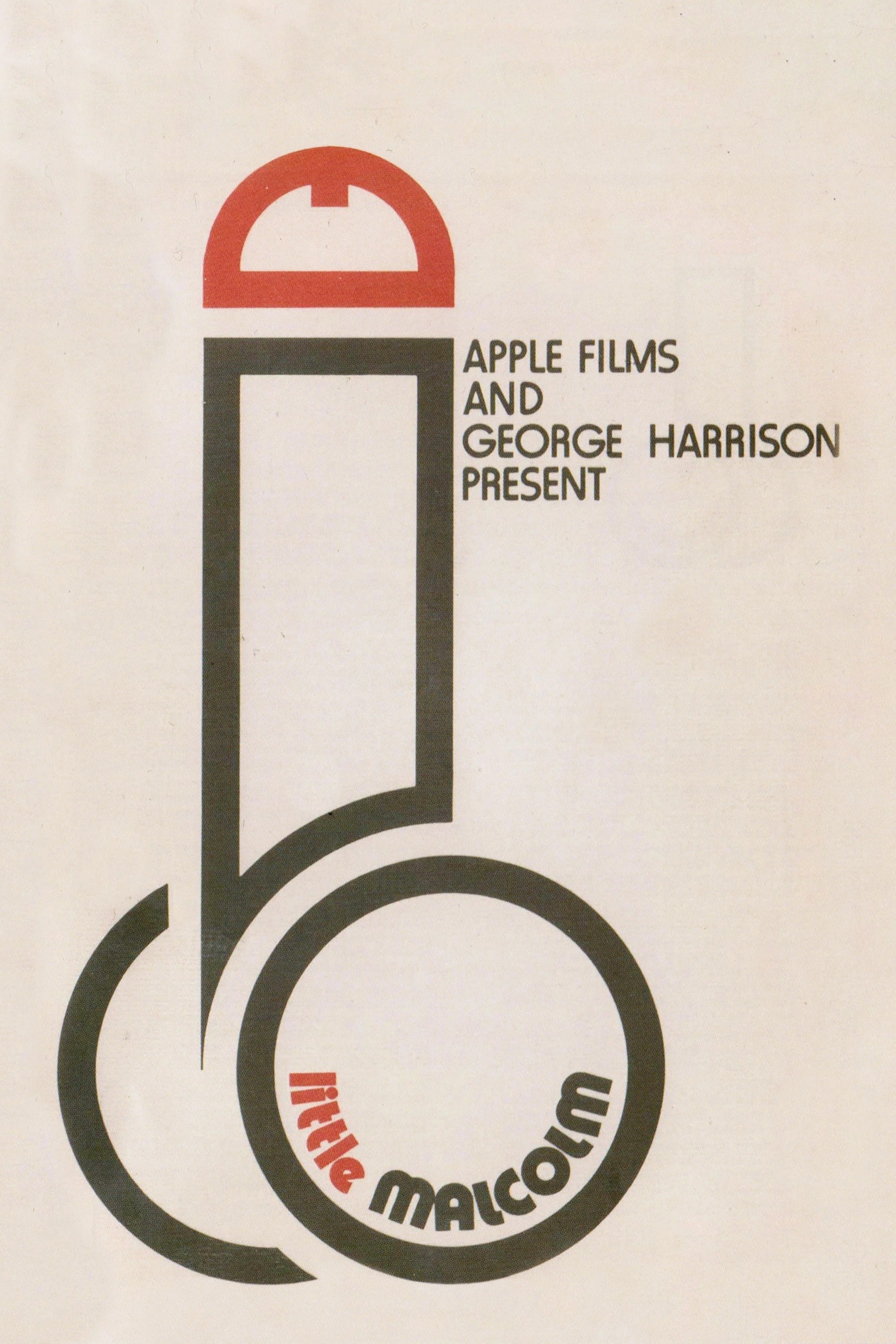
Before the Proud Boys, before the manosphere, there was … Little Malcolm and His Struggle Against The Eunuchs. Malcolm Scrawdyke (John Hurt) is a hyper-articulate, involuntarily celibate, perpetually wounded artist who forms the fascistic, misogynistic Party of Dynamic Erection, leading its other three members on a campaign of revenge following his expulsion from university. Adapted (quite obviously) from a play, the film is directed by Stuart Cooper right before he went off to do Overlord, and has the honor of being the first movie George Harrison bankrolled under Apple Films. It is a brilliantly written and brutally acted film that foreshadows some of our more embarrassing present-day thought leaders. Watch for free on YouTube; here’s the trailer:
* Comment of the Week comes from Seamarsh:
What we are witnessing is a replay of the 60s and 70s with shittier music
* Sendoff. Let it be stipulated that the late David Allan Coe was a problem. Unreliable narrator, tax scofflaw, deadbeat dad, rhinestone cowboy, jealous “Outlaw,” sworn enemy of Jimmy Buffett, and the type of person who could elicit a New York Times headline – in 2000, mind you, not 2020 – like “Songwriter’s Racist Songs From 1980s Haunt Him.” (Writer Neil Strauss accused Coe there of producing in his mail-order “X-rated” albums “among the most racist, misogynist, homophobic, and obscene songs recorded by a popular songwriter,” referencing tracks like “Nigger Fucker” and “I Made Linda Lovelace Gag.”) Watching son Tyler Mahan Coe, of the terrific Cocaine & Rhinestones podcast, try to describe the father that he (like the rest of his siblings) was estranged from, is pretty rough. But ol’ David Allan could write a damn tune—“Take This Job and Shove it” for Johnny Paycheck, “Would You Lay with Me (In a Field of Stone)” for Tanya Tucker, his own “Longhaired Redneck.” Coe’s signature song, the one that introduced me to him, was a cover, co-written by Steve Goodman and an uncredited John Prine, though D.A.C., as per usual, certainly added his own embellishments:
Liz Wolfe is back and she wrote a beautiful essay about the death of her son and life. It is deeply moving. I recommend it to everyone
https://reason.com/2026/05/04/project-freedom/
I have to agree with Matt about the omission of Not-Glenn Beck and with John Covil re: Michael Stipe and David Byrne (Yoakum idk about, see above: I am mostly country music illiterate) but if I was to choose an Andrew it'd be Andrew Bird