

Fair warning, this one’s long….
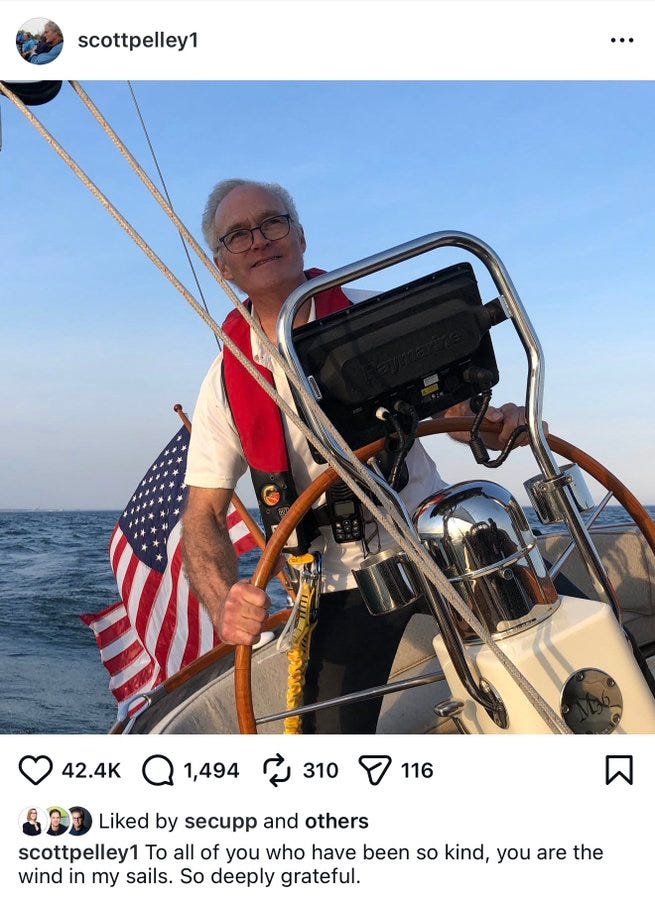
Since the three of us signed off Tuesday on our not-very-charitable-to-journalo-heroes analysis of the 60 Minutes kerf(l)uffle, Simpsons character and Bari Weiss murder-accuser Scott Pelley was fired, then alleged in a second post-firing statement that the new management had “instructed me to inject falsehoods and bias into a politically sensitive story,” and then sat down with recent Fifth Column live-show panelist Lulu Garcia-Navarro for the post-game New York Times interview, at which those “falsehoods” were revealed to be unheeded notes from Weiss asking that a segment on the Minnesota ICE conflict show more aggressive protest footage while describing Renee Good’s car as driving toward the ICE officer who shot her. There is no shortage of other recent news about a weekly news program that, as frenemy of the pod Jon Levine has noted, is being covered “like [it’s] the Yalta Conference.”
On the “Overtime” segment of Real Time w/ Bill Maher Friday, recent Fif guest Sen. Chris Murphy (D – Ct.) warned that “you’re watching a censorship state be created,” at which the host expressed skepticism that 60 Minutes has perceptibly changed at all, adding: “I don’t feel like Scott Pelley was a national treasure.”
I don’t have much to contribute to the current controversy, aside from reiterating that the Trump administration’s pressure on media companies has been godawful, that I think (my friend) Bari’s attempt to manage what is perceived to be a hostile takeover of a deeply entrenched media institution is a (very lucrative!) mistake, and that there are fewer Derangement Syndromes more potent than BDS. But, I’ve had some brush-ups over the years with 60 Minutes, CBS, and pompous media celebrities that this whole episode shook loose from the cobwebs.
From 1994:
Lesley Stahl of CBS’ 60 Minutes was more persistent [in pushing the journalistic narrative that Young Americans in Prague were there because they were disappointed in the United States]. She came to Prague around April or May of 1992, a few months after the landmark Chuck Powers story in the Los Angeles Times gave the YAP phenomenon the stamp of credibility, triggering a media stampede that has yet to cease. Never mind that Powers had trouble spelling people’s names correctly or getting their ages right or attributing his quotes to the individuals who spoke them -- this was one of the largest circulation dailies in America identifying a new trend. Every news organization worth its salt had to cough up plane tickets and match the story.
Of course, award-winning journalists know how to hunt for an original angle, and so Stahl decided, well in advance of her visit, that YAPs were basically chasing the Sixties legacy but lacking that generation’s moral commitment. She spent most of her session in the Prognosis office trying to goad all of us -- without success -- into bashing America and praising the Sixties.
Then, with a surreal flourish, Stahl turned the tables. “You know, I’m damn proud to be an American,” she challenged our bewildered staff. “You know, my generation cared enough about America to do something about it, we didn’t just run away!”
After clearly disappointing Stahl with my own inability to articulately criticize America’s faults in a one-on-one interview, I invited her to come see the band I was playing with at the time on the Charles Bridge. “Oh yeah!” she said. “You’ll have to play me a Sixties song!”
I explained to her that about the only cover we played was the very Seventies “Tie a Yellow Ribbon.” Then the conversation shifted to a nostalgic look back at Watergate, that high-water mark of the American free press, when the young Stahl cut her journalistic teeth. As we parted, she vowed to come to the bridge:
“I can’t wait to hear you play me a Sixties song!”
The 60 Minutes crew came out a few days later and filmed one of our two-hour sets in its entirety. We were careful to omit even “Tie a Yellow Ribbon,” so they would have to show us playing either originals or nothing at all.
Afterwards the producer came up to us and said, “Wow, that was really great, really great. Now we were wondering if you could play us just one Sixties song.”
* From a 2004 piece titled “Song for Dan Rather”:
The first, cheapest, and arguably best reason to despise someone is because he is rich, famous, and powerful. Bonus points if he works in your profession and carries on like a self-important jackass. Schadenfreude is a dish best served daily, and if America is rich enough to give around $7 million a year to not one but three different humans who have a job the Brits accurately call “newsreader,” then certainly we have more than paid for the right to laugh like pitiless hyenas at the sight of the great Dan Rather slinking away from his enviable post in half-shame, like an armadillo leaving an ant nest after mistakenly pissing on it.
The battle over Diamond Dan’s obit continues to be waged elsewhere. My own two cents has nothing to do with fonts, pajamas, liberal bias, or the name “Kenneth.” What irked me about Rather was that he was one of journalism’s all-time great self-flagellators, always eager to confess blame for the declining standards of the trade, always making sure to spread that blame out nice and thick on the rest of us…and always showing up on time to collect his seven-figure paycheck.
“In the constant scratching and scrambling for ever-better ratings and money and the boss’ praise and a better job, it is worth pausing to ask—how goes the real war, the really important battle of our professional lives?” Rather once asked in a noted speech in front of the Radio and Television News Directors Association, worth quoting at length. “How goes the battle for quality, for truth, and justice, for programs worthy of the best within ourselves and the audience?… “The answer, we know, is, ‘Not very well.’ […]
That speech was delivered in 1993. Since then, Rather has pocketed well over $50 million from CBS. Yet his we’re-all-not-worthy song has remained very much the same.
* Sorry, that was a lot of words. Here’s some video, from our Members Only #326 episode with Noah Rothman about political violence:
We also talked with Rothman about political violence in 2018, and here’s a January 2020 episode w/ him that must be fascinating to revisit: “The Case for F*cking Iran Right Up.”
* On The Reason Roundtable this week, I was asked/baited to respond to Mike Pence‘s recent assertion that Republicans have “lost our way” but Democrats “have lost their minds.” My edited answer, as you can imagine, included heapings of both Platner and Paxton:
* Speaking of Maine’s favorite oyster farmer, it’s been like three whole weeks days since The New York Times came out with an article about how three women who had dated him described “volatile and ‘toxic’ relationships” that “in at least one case, [was] even physically threatening.” He was also portrayed as drinking heavily, shagging everybody, and – contra to his repeated, not believable claims – so aware of the Naziness of his tattoo that he called it “my Totenkopf.” One of the ex-girlfriends, a professional conservative named Lyndsey Fifield, has plausibly accused the Times of misrepresenting the paper’s intentions and softening her testimony.
I find myself nodding in mostly vigorous agreement with David French (#191, #325, #365, #555):
It’s not just the evidence of assault.
It’s not just the Nazi tattoo
It’s not just lying about the Nazi tattoo
It’s not just the Kik account
It’s not just the adulterous sexting
It’s not just the deranged posting
It’s all of it (and the more that may emerge).
This is the guy you want to burn your moral credibility for to beat ... Susan Collins?
* Kmele & the Tanglers this week talked about Spencer Pratt and screwworms:
* A week ago, our pal Kat Rosenfield (#448) reacted thusly to a Twitter discussion about how people process those who went bananas during Peak Woke but are now just kinda pretending it was a minor temporary fever: “As a liberal who was unpersoned during peak woke for dissenting from the orthodoxy on things like cultural appropriation, my measured opinion is that the people who perpetuated that culture simply should never have power again; they clearly can’t be trusted with it.” This led The Bulwark’s Tim Miller to snark: “’unpersoned’ but still posting. The great awokenings very own Lazurus.” Cathy Young seconded that it was “pretty over-the-top hyperbole,” adding: “I agree that illiberal leftism shouldn’t be minimized. But there are plenty of people who were canceled far worse than Kat who haven’t gone Trump apologists.”
This would mostly be a not-worth-mentioning example of why opinion journalists and commentators should have their phones taken away, except that it produced a very recommendable Rosenfield essay titled “On Being Canceled Before it Was Cool. I got better, but being a newt actually did kind of suck.” This Firehose is already too long, but sometime soon I will compile a bunch of our past episodes with people who have been cancelled and/or were pushed out of media properties they either created or were star talents at.
* Another recent essay of note that I’m placing here largely to avoid it being posted to the Chat for a 17th time comes from Sam Harris: “Why I Won’t Debate Critics of Israel.”
* Yet another good written piece that was republished by Persuasion this past week comes from Vice washout Harry Cheadle: “The Digital Media Era Is Definitively Dead: A requiem for a more optimistic time.” Semi-conclusion:
[O]ur collective dream is gone. We were supposed to build… what? I’m still not sure what the end goal of the digital media era was. A more populist vision of journalism, where reporters and editors were accountable to their audiences? A shared cultural and political vocabulary that would cross borders and define a generation? A forum for frustrations with the “establishment,” whatever that might mean? Just a platform for a lot of young media talents?
Whatever we were trying to do, it failed. The money is gone. The jobs are gone. The websites we made are atrophying into junk floating around in cyberspace. I don’t know if anyone will believe me, but man, it was fun while it lasted.
(Never forget our episode on “The End of Vice”!)
* I wrote a thing at the beginning of this past week about how the reasons we are justifiably nostalgic about the Bicentennial do not have much to do with the desires of top-down planners (particularly on the federal level), and in fact had a lot more to do with kitschy commercialism, local goofballs, and Rocky. The kicker:
We cannot, and should not want to, replicate an era when the government constriction of choice corralled most of us into consuming the same or similar media content. But for that vast, vast majority who do not view patriotism as problematic and who love this big and wonderful and horrible country for exactly what it is, there’s a bicentennial lesson just laying there: make it local, embrace the commercial, chortle through the pain, and stop giving the president of the United States even one flying fuck.
* Time for Producer Jason’s Video Vault!
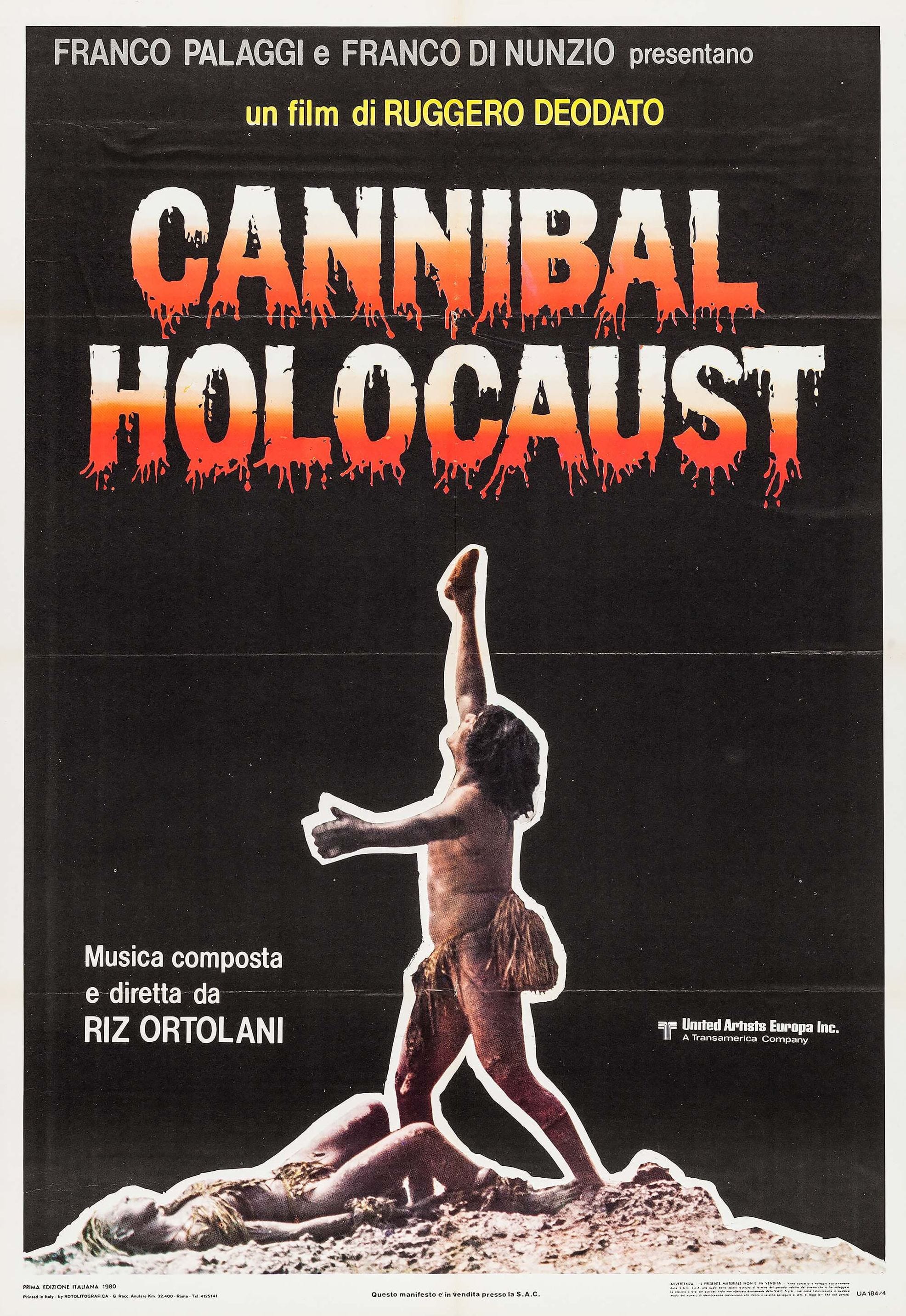
Cannibal Holocaust, like The Fifth Column, is not for everyone. Its selection here is not a recommendation that you see this film—in fact, there are parts of it that I wish I hadn’t. But with Scott Pelley and the 60 Minutes sanctimony on the brain, I started trying to think of films in which journalists are the bad guys, and though The Green Berets gets an honorable mention, Ruggero Deodato’s 1980 banned-in-a-zillion-countries shockfest takes the cake. In the first act, we learn of a documentary film crew working in the Amazon to capture exclusive footage of an indigenous cannibal tribe that has gone missing. An on-camera reporter explains that NYU and the “Pan American Broadcast System” are sending a noted anthropologist in after them to solve the mystery, because, well, enquiring minds want to know. Long story short, the good professor finds them, or at least their remains—and their FOOTAGE. As you can imagine, the network is hot on seeing a quick turn of this tragic documentary, making clear they have few qualms with the director’s history of staging scenes. The professor (reluctantly?) dives into the raw footage and witnesses the crew graphically mutilating a giant turtle (no special effects here, folks), massacring villagers, and pitting tribes against each other. Eventually, the good professor has had enough. “This so-called documentary footage is offensive, it is dishonest, and above all it is inhuman,” he screams at the news execs. Their defense? “What you saw is a rough cut!” But the professor has an ace up his sleeve, telling the suits that they haven’t seen the material that their editors didn’t have the stomach to string together. They all file into a screening room and that’s when it gets much, much worse. It is one of the most aggressive media critiques in film history. Is it a bit over the top? A touch. But it helps balance out the cinematic impact of All the President’s Men. Stream on Shudder; buy the BluRay; here’s the trailer:
* Comment of the Week comes from Ameya A:
Can I suggest another experiment? Listener questions for guests! Tyler Cowen does it and sometimes gets some good ones. You’d have to ruin the surprise by telling us who you’ve booked but you could limit it to paid subscribers (or NFC-only, sorry economy-plus subscribers) with <24 hours notice.
Good idea!
Sendoff: “You know she ate a pizza / dancing to the beat…” Among the many wondrous discoveries I made four decades ago during freshman year – Newspapers! Ladies! The Replacements! –was an economics lesson in unfashionability. Which is to say, the cheapest clothes, art, and records one could find at the many nearby thrift stores in 1986/87 were anything redolent of the disco-era 1970s. You could get entire, good-condition, mustard-colored polyester leisure-suit combos (including vests with barrel-tassel buttons!) for a buck or two; fat-era Elvis posters for peanuts, and for the princely sum of one quarter literally every single once-gigantic, then-embarrassing album: The Saturday Night Fever soundtrack, pink-leather Rod Stewart, anything by Barry Manilow. By this fantastic arbitrage opportunity I quickly amassed what must have been one of the largest disco collections in these United States. Combined with a change of roommates, and the equally important economic discovery of $3.99 cases of Schaefer, this made our apartment a bedraggled, punk-hippy Isla Vista version of Studio 54 for about six spectacularly degenerate months of 1987. Fitting for an era full of mullets, the nightly soundtracks were business in the front (R.E.M., Stones, Sex Pistols), party in the back (so … many … K-TEL records!). At first, people assumed the Isaac Hayes and K.C. & the Sunshine Band stuff was ironic, and would dance along as a goof, but before long everyone realized that A) dancing is fun! (also incompatible with college rock), and B) holy shit, some of these records are great.
Probably a top-10 dancefloor song of that era, on vinyl I still own (sadly, an entire Mustang full of my collection was thieved in 1988 & never restored), was the #1 smash “Boogie Fever” by The Sylvers, who were sort of the West Coast version of the Jackson 5—huge family act (9 of 10 siblings from Watts), huger afros, and an adorable young’un destined for solo stardom. That cute boy was Foster Sylvers, who died this week at age 64 from pancreatic cancer. Sylvers put out a solo album at age 11 even before officially joining the band, and ended up playing bass with his siblings. As foreshadowed, disco collapsed, and with it many artists associated with the genre, including The Sylvers. Foster kicked around the music biz for a while, and eventually kicked around … the sex offender registry, upon a 1994 conviction for sexually assaulting an unconscious woman. (We do warts-and-all around here!) Here’s his biggest hit, going all the way to #22 on the pop charts … “Misdemeanor.”
I direct those who want to hear Kat’s perspective in addition to reading her post to listen to her synopsis on the latest Feminine Chaos. (First though, a crestfallen PMB musing why the NYT published a long column that never once referenced the whole damned book on the topic by Phoebe that came out just last month… which really does sound like some mean-girling by the Times/columnist.)
https://femchaospod.substack.com/p/its-our-podcast-and-well-be-smol?r=7enhd&utm_medium=ios
I am thankful for the 5th for two reasons this week. That for every guest like Chris Murphy, we get a Noah Rothman or a Bridget Phetasy(hint) and a great non guest episode like we got this week. The other reason is Matt's word Smithers. With a gem like Bonus points if he works in your profession and carries on like a self-important jackass. Schadenfreude is a dish best served daily, and if America is rich enough to give around $7 million a year to not one but three different humans who have a job the Brits accurately call “newsreader,” then certainly we have more than paid for the right to laugh like pitiless hyenas at the sight of the great Dan Rather.." 😂✊️