

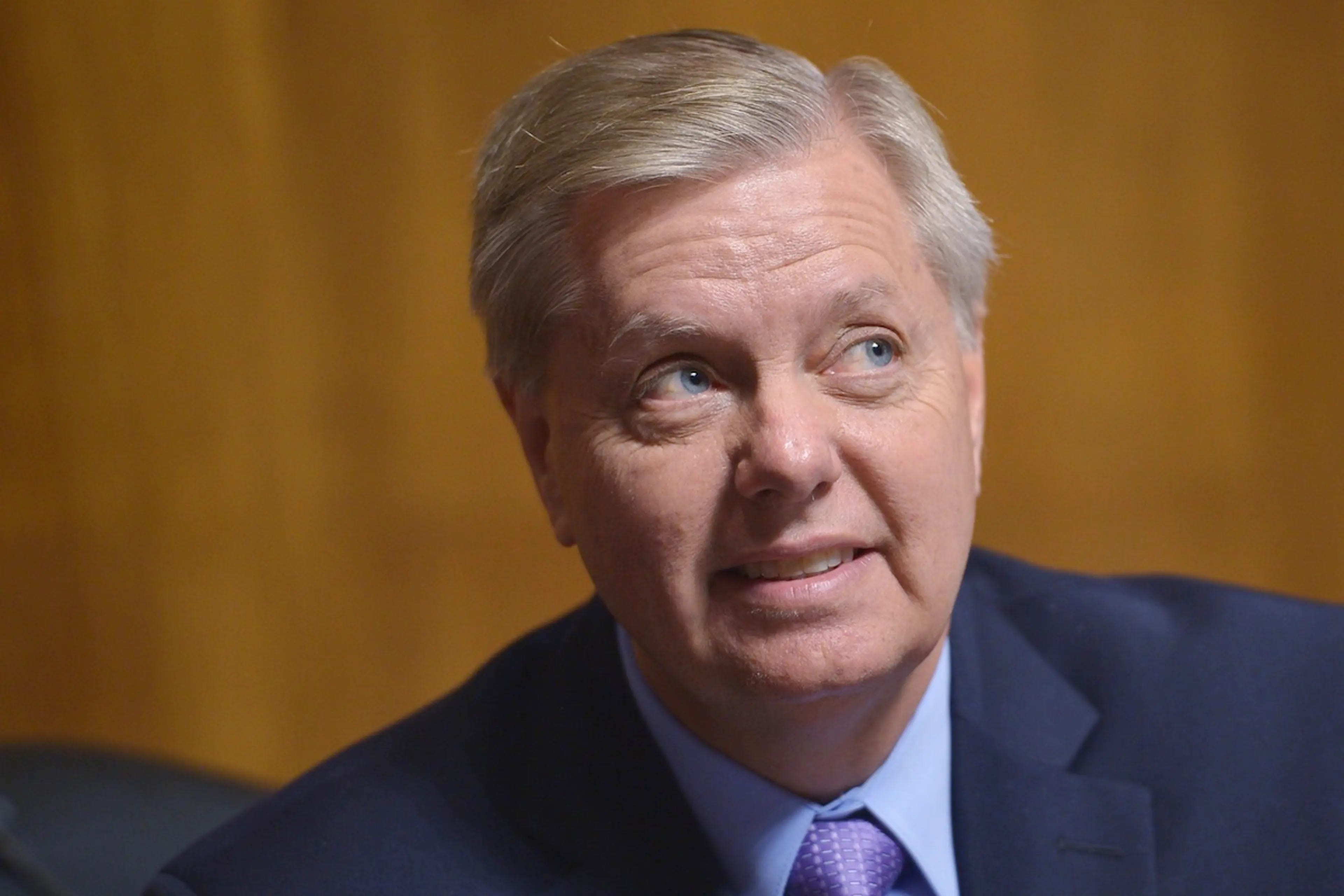
There was always something intriguing about Lindsey Graham, who died unexpectedly Saturday from an aortic dissection at age 71. Or perhaps better put, people who are into politics disproportionately found Graham intriguing, whether because of his confirmed bachelorhood, his lacerating wit (so righteous and wicked when he was on your side, so hyperbolic and partisan when he wasn’t), or his neck-snapping heel-turn vis-à-vis Donald Trump. It was that latter journey—from withering critic to obsequious supplicant—that made John McCain’s erstwhile mini-me a Top 5 contender over the past decade for the political reality show What HAPPENED to That Guy?
I always found those green-room conversations weird. What happened to Lindsey Graham was the same thing, more or less, that happened to J.D. Vance, Based Mike Lee, the leadership (for a while, anyway) of the Libertarian Party, and maybe half the contributors to National Review’s “Against Trump” issue. Politicians especially, but also those in other politics-facing professions, are keenly interested in influencing the exercise of government’s massive power. The price of maintaining the ability to do so during the 45th and 47th presidencies has been a willingness to gratify Trump’s ego, often by kneecapping one’s own. There’s a reason why sworn ideological enemies and 2016 GOP primary humiliatees (totally a word) Rand Paul and Lindsey Graham elbowed one-another to be Donald Trump’s golf partner—each senator held strong geopolitical views that they wished to see reflected in policy.
The question of What happened to that guy is more personally comforting than its usually more pertinent corollary, which is: What happened to YOU? Why did you make the mistake of thinking that an elected politician who sometimes (even thrillingly!) overlaps with your policy preferences would not act like a typical politician seeking re-election? Katherine Mangu-Ward may be wrong about not voting, but she’s dead on with the other of her most foundational axioms: Never fall in love with a politician, they’ll inevitably disappoint you. You would think that this would be a basic standard among journalists. And you would be wrong.
* Which brings us to Graham Platner. You may recall on episode #554, New York Times opinion columnist Michelle Goldberg was so defensive of the (pre-sexual-assault-allegations) oyster farmer that she uttered the words, “Again, I kind of understand as I’m saying this, why somebody would find my belief, like, not credible, right? Like, why especially somebody’s who’s not kind of like not preordained, to be like a little bit sympathetic to his politics would not ever want to give him the benefit of the doubt. I can understand, I’m guessing that probably most of the people watching this think like that either you’re deluding yourself or your bullshitting us. Nevertheless this is really how I see him.” Well, fast-forward to this past Monday, when (as we discussed on #565) Goldberg criticized the people who looked the other way as Platner’s red flags accumulated, including herself. Here’s a notable passage:
Last October, when stories about Platner’s tattoo and Reddit posts first broke, I went to Maine to write about him. I tried to convey what I saw: a campaign that was electrifying angry Maine voters. But I deeply regret that, impressed by Platner’s political charisma, I wrote that he was “nothing like the edgelord caricature I encountered online.” If anything, he seems to be significantly worse. […]
If there’s a lesson here, it might be about the importance of listening hard to the people telling you what you don’t want to hear. Many Democrats, disgusted by their party’s failure to contain Donald Trump, want representatives as furious as they are, and they no longer trust their leaders to tell them who is electable. That opens space up for outsider candidates who wouldn’t have had a chance a few years ago. It also makes it easier for unfit characters to escape proper vetting.
Platner offered many on the left something they’re desperate for: working-class aesthetics married to uncompromising lefty politics.
In other words (and by admirable confession), she fell in love with a politician, because of his charisma and dreamy politics. Now let’s go to another post-Politico reckoning from a recent Fifth Column guest, Sebastian Junger, who had written an enthusiastic profile of Platner just five weeks prior. Junger’s (very high) journalistic value is as a features/books author, not as a political commentator, so I won’t speed-bag everything in this passage. But there are some available lessons here seemingly just outside his grasp:
[A]long with the excitement, I think there was also a sense among supporters that the other shoe was going to drop, and now that it has, they can finally move on. I include myself in that category. The pity of this predicament is that people who were politically energized by his message — including a large majority of women in the New York Times comments section — found themselves at risk of appearing to be apologizing for a serial abuser. One friend told me that his ultra-feminist wife was devastated by Platner’s downfall, as were many of her female friends. She blamed it on “the Democrats.” […]
Platner represents the kind of economic populist that I believe America needs during a time of staggering corruption and income disparity, and I also resent the fact that such noble positions are now paired with sexual abuse. […]
[I]t’s vitally important to continue upholding the kind of anti-war, anti-corruption, anti-corporatist platform that Platner so brilliantly articulated. His is a strain of American populism that goes back more than a century and could just as easily fit a Democratic candidate as a Republican one. A lot of things can be extracted from Platner’s painful implosion, but perhaps the most important is the realization that most Americans crave economic justice. Our society has created a small number of grotesquely wealthy people, but we are somehow all discouraged from discussing that with our political adversaries. Platner’s brilliance was that he did not see that boundary; he saw no boundary except the one between the vast majority of decent, hardworking people and the political elites. If either party wants to salvage its corrupt and degenerate reputation, I would suggest listening to Platner’s campaign speeches. For many people — despite his massive failures — this man spoke the truth.
In other words, Junger overrode his own hunch that “the other shoe was going to drop,” because of Platner’s charisma and dreamy politics.
Does the journalistic/civic ability to detect bullshit only function when not in thrall to a candidate’s mellifluous political rap? It bloody well shouldn’t! I was never a Lindsey Graham fan, but he was besties with a senator I did like, John McCain. Because I’m at heart a basic-bitch journalist, I yielded to what so many other people in my profession did in 1999-2000, which was to fall hard for the beautiful loserdom of the Straight Talk Express. This led me to McCain’s captivating post-campaign memoir, Worth the Fighting For (co-authored, as all his books were, by Mark Salter), then the more ballyhooed Faith of My Fathers, after which I began noticing personal and ideological patterns, and massive gaps between perception and reality, that seemed to elude most everyone else in the star-struck press corps. The resulting work – newspaper feature, magazine cover, book – read as critical, because there was a lot of puncturing going on (including at the media!), though it was also an overdue attempt to treat him seriously as a thinker and political actor. The idea of thinking, “I like this guy, so I’m going to give him a pass on X, Y, or Z,” is as alien — and ultimately condescending — as thinking in Esperanto.
* OK, this is already long-winded, and we haven’t even got to my long Trump-corruption feature, so let’s pivot to video. First, Kmele talking Platner on CNN:
* Second, Kat Rosenfield talking Platner on the Fifth:
Kat expanded on some of those ideas over at her Substack.
* Third, Kmele talking Platner on Tangle:
* Hey, did you know Mike Pesca stopped The Gist after 12 years? Check out his final show, in which “Mike lays out his broadcasting philosophy: the importance of production values, the tradeoffs between chasing advertisers and risking insularity with paid subscriptions, and what makes for a great interview and great audio…. [O]ffers recommendations for what to listen to in a Pesca-free future, and reflects on where podcasting goes from here.” You can also find Pesca in our archives, on episodes #343, #418, & #467.
* OK, Trump-corruption o’clock. Reason on Thursday published twin features trying to wrap our arms around the scope of corruption in this second administration. My ever-meticulous colleague Jacob Sullum drilled down into some of the most egregious examples/attempts, whereas I worked back from whataboutism, starting from the most notorious example of corruption in U.S. history, and asking: In this category, how does Trump 2.0 compare? The answer was largely: Worse, much worse.
For those with short attention spans, you can read my Twitter thread. For those seeking a taste without clicking on anything, here’s three paragraphs:
Four days before Trump’s second inauguration, a company called Aryam Investments 1 signed a deal with the president-elect’s son Eric to buy a 49 percent stake in World Liberty Financial for a reported $500 million, half of it in cash up front. The Trump family received $187 million overnight, and the family of World Liberty Financial co-founder Steve Witkoff, who by then was already conducting sensitive Middle East diplomacy on behalf of the incoming president, received an additional $31 million, according to The Wall Street Journal. Amazingly, the transaction was made in secret, revealed only one year later.
Did Aryam Investments have any pressing regulatory business in front of the U.S. government? Quite a bit, yes. The firm is owned by Sheikh Tahnoon bin Zayed Al Nahyan, the national security adviser for the United Arab Emirates (UAE), brother of the nation’s president, and head of the country’s $800 billion sovereign wealth fund. Tahnoon’s artificial intelligence company G42 had been prevented by the Biden administration from acquiring advanced Nvidia AI chips over national security concerns that it might share the technology with China. That was reversed with a bang in May 2025, when Tahnoon received what The Wall Street Journal described as “a coup for the U.A.E.’s ruling family”—an agreement from Washington to send the UAE 500,000 high-powered AI chips per year, including to the previously verboten G42. “Enough to build one of the world’s biggest AI data center clusters,” the Journal noted.
So a foreign government official’s secret $500 million deal that personally enriched the president and his family, plus a key Mideast diplomat and his family, preceded by six months a massive regulatory reversal that will further enrich said official and his country. But that’s not all. In December 2024, Tahnoon’s asset management firm Lunate was one of two entities to inject $1.5 billion into the investment firm owned by Trump’s son-in-law, Jared Kushner (who has co-led Mideast diplomatic initiatives with Witkoff). And we are still not done. Remember that aforementioned $2 billion Trumpcoin-denominated investment into Binance by the UAE company MGX in May 2025, just prior to the UAE chip deal? MGX is owned by none other than Sheikh Tahnoon bin Zayed Al Nahyan.
Random question for the peanut gallery: I used to do audio versions of my Reason articles, sometimes w/ some extra jackassery. Would some of you like me to start doing that again?
* Moar Fifth Column YouTubery that I forgot to link to last week, beginning with Sarah Isgur on birthright citizenship:
* And Adam Carolla on Michael Jackson’s weird dad:
* Events! July 14 is an Epstein Files debate at the SoHo Forum in NYC between Michael Tracey (veteran of episode #105) and Marcella Szablewicz on the resolution: “The Jeffrey Epstein scandal has become a case of moral panic.” And Nov. 4-6 we will be podcasting from the Foundation for Individual Rights and Expression’s Soapbox 26 conference in Philadelphia, along with fellow speakers Sarah Isgur (Members Only #314), Noam Dworman (#549), David French (#191, #325, #365, #555) Nick Gillespie (S.D. #72, #379, M.O. #251, #551), Greg Lukianoff (#216, M.O. #183, #427, M.O. #276), Jacob Mchangama (#102 & #344), John McWhorter (#84, #121, #188 & #366), Matt Taibbi (#226, #348), and Ilya Shapiro (#361), for starters. Make sure to use the discount code FIFTH to save $50 on tickets.
* Speaking of Lukianoff, he had a Washington Post Op-Ed this week, headlined “The Trump Administration Is Cracking Down on Dissent. That’s Chilling.”
* Time for Producer Jason’s Video Vault!
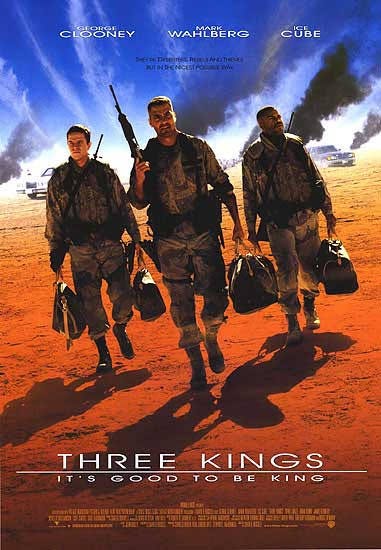
“This is Naotoshi Okada, he’s the CEO of Nikkei,” I would say by way of introduction. “And this is Spike.… Spike was in Three Kings.” Back when I worked at VICE, this was my favorite way to introduce VICE Creative Director Spike Jonze while giving tours to visiting journo types. It’s not that Spike hadn’t done more impressive things since then (or before), it’s just that he doesn’t get enough praise for his excellent performance as PFC Conrad Vig in this still-underrated film. Set at the end of the Gulf War in 1991 (see, another anniversary!), Three Kings follows George Clooney, Mark Wahlberg, and Ice Cube as American soldiers on a Bush-era update of Kelly’s Heroes. After failing to see much action in the fleeting conflict, the Americans would like to at least return home rich – and plan to do so by liberating a secret stash of Saddam’s gold bullion. Despite some predictably earnest editorializing (I mentioned George Clooney is in the movie, right?), it’s a sharp, funny, and highly stylized film with Norah Dunn doing her best Christiane Amanpour and the greatest use in any medium of a song by the rock group Chicago. Watch for free (with ads) on Pluto; buy the BluRay; here’s the trailer:
* Comment of the Week comes from Shane:
Pouring one out for Graham while watching his highlight reel one last time:
Sendoff: Of course it’s Bonnie Tyler, but it’s not gonna be “Total Eclipse of the Heart,” even the eternally untoppable literal video version. But before we get to one of my favorite late-‘70s heartbreak songs, did you know that our Welsh chanteuse was not born with Rod Stewart-like pipes? Her first album, pre-vocal-nodes surgery, reveals a singer more in the Olivia Newton-John/Juice Newton lane, as you can hear on her first hit, 1976’s “Lost in France.” Anyhoo, I will confess to having a vulnerability for breakup songs circa 1977-78, since that coincided with many significant developments of my childhood (not least of which was finally getting my own room, and clock radio!), but I submit that this is still a banger, made complete by her weird Welsh vowels:
Audio articles would be great!
I think the comparison to, say, Mike Lee is a bit unfair. Many on the right abandoned all of their stated principles to become windsocks inflated by and pointing in the direction of Trump's hot air, whichever way it was blowing on any given day. Graham, however, stuck to his guns on foreign policy, never abandoning Ukraine even when it would have been convenient to do so.
Trump is a man who drains the honor out of everyone around him, and sometimes I wonder about the honor in sacrificing your honor to defend what's right. Graham tarnished his legacy by befriending Trump, but used that friendship to steer Trump in small ways toward supporting Ukraine, and Israel, and the free people of the world against the illiberal enemies of humanity. It looks a lot like tarnishing his legacy to maintain power. Maybe it was a bit of both.