

In our Members Only #341 episode with Semafor co-founder Ben Smith, I put forth the proposition that, with the twin collapses of the journalism industry and demand for non-national political news, the information-consumption market has devolved into basically one massive general-interest newspaper (The New York Times, though the Wall Street Journal similarly dominates biz/finance), and one premier news magazine. Which I suggested, erm, was The Atlantic.
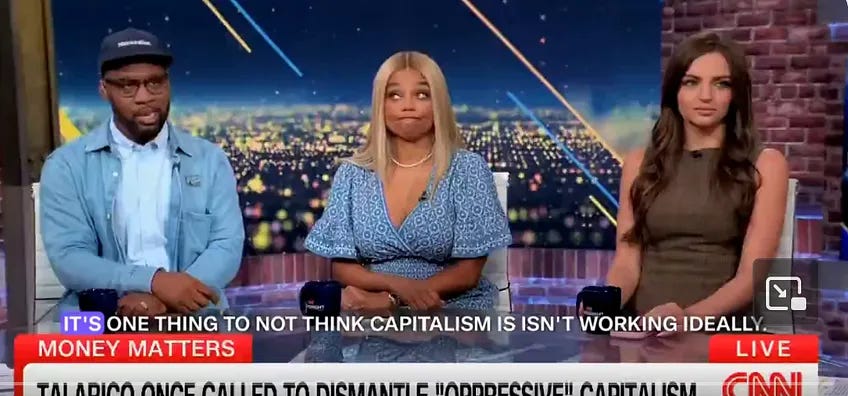
On Tuesday night, not long after our taping of M.O. #342, Kmele went on CNN and sat next to The Atlantic’s Jemele Hill. The results did not bolster my hypothesis:
“Black Entrepreneur Humiliates Jemele Hill on CNN After She Claims Capitalism and White Supremacy Are Connected,” went the somewhat unknowing headline over at The Western Journal (the exchange was also covered by Fox News and Twitchy). Kmele’s performance was praised by Ben Shapiro, Mary Katharine Ham, Matt Taibbi, Steve Guest, Derek Hunter, Scott Jennings, Emily Jashinsky, Kennedy, Anthony Brian Logan, Stephen L. Miller, Spencer Klavan, Sage Steele, Brad Polumbo, Ian Miller, Jeff Charles, Peter Heck, Matt Vespa, The Officer Tatum, Doc Rich, Brianna Lyman, Rikki Ratliff, Yemisi Egbewole, and Drew Holden, among others. Less impressed were Marc Lamont Hill and Roland Martin (the latter of whom called our co-host a “fool”).
In a couple of Twitter follow-ups, Hill, who had been suspended from ESPN in 2017 for calling Donald Trump a “white supremacist who has largely surrounded himself w/ other white supremacists,” elaborated on the connection between white supremacy and capitalism:
America was built on the institution of slavery. It is how America became a world economic power — the buying and selling of people being tied to the economy. That is effectively white supremacy, since it was a race-based system.Fast forward to other economic policies that were guided by race — housing, employment, etc. There were rules that prevented Black people from equally participating in the free economy.
In fact, one of the most glaring features of American capitalism is racial inequality. The racial wealth gap exists because specific policies were put in place to suppress economic participation.
So yes, capitalism is tied to white supremacy.
And then:
I never said capitalism was racist. I said that there is a relationship between capitalism and white supremacy because of how it functions in America. You all are sticking to theory and not looking at the fact that we practice racialized capitalism in this country.
If capitalism were operating in the pure form that you want it to, then there wouldn’t be such a significant racial wealth gap. But there is a racial wealth gap because we exist under a racial construct whether you like it or not.
That does not mean that there are not individuals who are able to achieve despite this construct. But we know that the salaries and pay of white men are higher than those of Black men, Black women, and Latinos. Because in this country value is attached to race.
Don’t get mad at me. Get mad at the institutions.
Kmele, for his part, chose Tangle for the post-game:
* Hill’s contention that slavery was fundamental to the success of American capitalism has long been in vogue among the softer-headed corners of the journalistic and academic left, reaching peak visibility in The 1619 Project by The New York Times. One year before that Nikole Hannah-Jones “new origin story” for the United States, the marvelous economic historian Deirdre Nansen McCloskey published a relevant Reason piece titled “Slavery Did Not Make America Rich.” Excerpt:
[T]he economic idea implied—that exploitation made us rich—is mistaken. Slavery made a few Southerners rich; a few Northerners, too. But it was ingenuity and innovation that enriched Americans generally, including at last the descendants of the slaves. […]
[E]ach step in the logic of the King Cotton historians is mistaken. The enrichment of the modern world did not depend on cotton textiles. Cotton mills, true, were pioneers of some industrial techniques, techniques applied to wool and linen as well. And many other techniques, in iron making and engineering and mining and farming, had nothing to do with cotton. Britain in 1790 and the U.S. in 1860 were not nation-sized cotton mills. […]
Growing cotton, further, unlike sugar or rice, never required slavery. By 1870, freedmen and whites produced as much cotton as the South produced in the slave time of 1860. Cotton was not a slave crop in India or in southwest China, where it was grown in bulk anciently. And many whites in the South grew it, too, before the war and after. That slaves produced cotton does not imply that they were essential or causal in the production. […]
We need to stop using the history of slavery to bolster anti-capitalist ideology. Ingenuity, not exploitation by slavery or imperialism or finance, is the story of the modern world.
Phillip W. Magness plowed similar ground in his Reason review of the 1619 book:
[I]n the original 1619 Project[,] [Nikole-Jones’s] opening essay there declared that “one of the primary reasons the colonists decided to declare their independence from Britain was because they wanted to protect the institution of slavery.” In early 2020, [New York Times Magazine Editor in Chief Jake] Silverstein begrudgingly amended the passage online to read “some of the colonists” (emphasis added) after Northwestern University historian Leslie M. Harris revealed that she had cautioned Hannah-Jones against making this claim as one of the newspaper’s fact-checkers, only to be ignored.
The ensuing litigation of this passage across editorial pages and Twitter threads unintentionally revealed an unsettling defect of the Times‘ venture. The 1619 Project was not a heterodox challenge to conventional accounts of American history, as its promotional material insinuated. An endeavor of this sort could be commendable, if executed in a scholarly fashion. Instead, the original essays by Hannah-Jones and Desmond betray a deep and pervasive unfamiliarity with their respective subject matters.
When subject-matter experts pointed out that Hannah-Jones exaggerated her arguments about the Revolution, or that Britain was not, in fact, an existential threat to American slavery in 1776 as she strongly suggested (the British Empire would take another 58 years before it emancipated its West Indian colonies), she unleashed a barrage of personally abusive derision toward the critics. Brown University’s Gordon S. Wood and other Revolutionary War experts were dismissed as “white historians” for questioning her claims. When Princeton’s James M. McPherson, widely considered the dean of living Civil War historians, chimed in, Hannah-Jones lashed out on Twitter: “Who considers him preeminent? I don’t.”
The 1619 Project did not simply disagree with these subject-matter experts. Its editors and writers had failed to conduct a basic literature review of the scholarship around their contentions, and subsequently stumbled their way into unsupported historical arguments. While some academic historians contributed essays on other subjects, none of The 1619 Project’s feature articles on the crucial period from 1776 to 1865 came from experts in American slavery. Journalists such as Hannah-Jones took the lead, while highly specialized topics such as the economics of slavery were assigned to nonexperts like [Princeton sociologist Matthew] Desmond, whose scholarly résumé contained no prior engagement with that subject.
As I mentioned (coincidentally enough) at the outset of M.O. #342, fear of slave revolts in the 18th century Caribbean and West Indies drew the other 13 colonies closer to England’s embrace. Three relevant recent paragraphs from me:
Andrew Jackson O’Shaughnessy’s 2000 book, An Empire Divided: The American Revolution and the British Caribbean, suggests an additional context [about Thomas Jefferson’s slavery hypocrisy] worth considering. There were not 13 British colonies in 1776 America, O’Shaughnessy reminds us; there were 26, including the wealthy sugar islands of the West Indies. These plantation economies had much more in common, commercially and culturally, with the American South than either did with the Northeast: huge cash crops, constant maritime exchange, and massive slave populations (90 percent in Jamaica, 60 percent in South Carolina and Georgia, 40 percent in Virginia). With the last came boundless human cruelty, widespread disease, and a thrumming fear of armed revolt.
Terror at the prospect of slave rebellions—such as Tacky’s Revolt in Jamaica, which began in 1760, lasted a year and a half, and took 500 lives—helped bind the West Indies closer to the bosom of Mother England, positively begging to quarter more British troops. Partly as a result, the 13 mainland American colonies were the only ones to revolt.
We can and should look upon Jefferson’s slavery blind spot as the ultimate revolutionary failure, a sin utterly unoriginal from an otherwise extraordinary man. But we may also ask ourselves why the South nevertheless rebelled when the West Indies did not and how a man of this time and place came to pen what Frederick Douglass would call the ‘promissory note’ of true American emancipation. The world’s first abolitionist society opened its doors in 1775 Philadelphia. As with issues of democratic participation, the Founders helped create a world they were not yet ready to live in.”
* Related Comment of the Week, from Philip Pomerantz:
I would also recommend Richard Bell’s recently published The American Revolution and the Fate of the World. It is a comprehensive look at the many parts of the globe that were affected by our Revolution. The Caribbean is part of that. Jack Henneman recently interviewed him. It is worth a listen, as all of Jack’s output is.
We discussed The 1619 Project on #151, #163, Special Dispatch #12, S.D. #26, #205, S.D. #68, S.D. #94, M.O. #189, and #227. Some on-point, listener-beloved Kmele-led conversations with various special guest stars include “Linguistics, Race, Antiracism” (Dec. 2017), “On Anti-Racism” (Nov. 2018), “Unlearning Race” (Oct. 2019), “On Pandemic Racism” (April 2020), “On Anti-Racism II” (June 2020), “Racial Identity, Abolition and Reckonings” (July 2022), and “Notes on White Privilege” (Sept. 2022).
* The re-booted Moynihan Report is off to a start that’s beginning to rival John Paciorek. Here, in full, is KISS front-man Gene Simmons, a.k.a. Chaim Vitz, talking about “his mother’s survival of the Holocaust, coming to America, KISS, Bob Dylan, money, marriage, and why the music business isn’t what it used to be.”
* Time for Producer Jason’s Video Vault!
“I’m an expert on tits. Tits and peanut butter.”
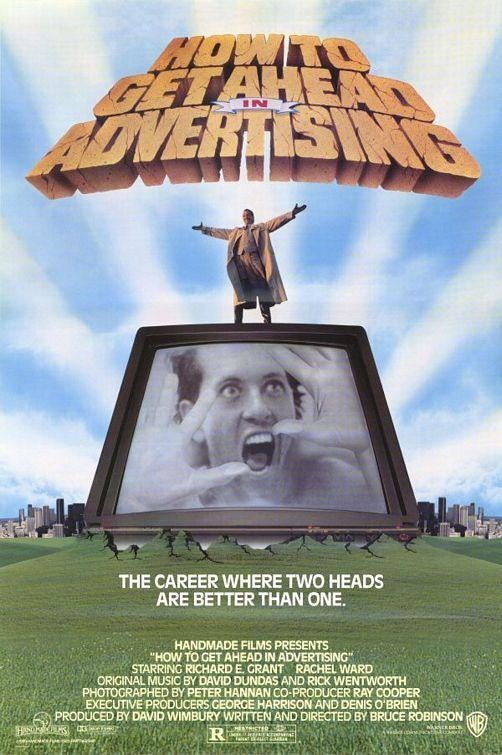
As briefly mentioned by Moynihan during Episode #572, British director Bruce Robinson made just a handful of films, but the ones he did left a mark. Two years after his debut, the incomparable (and autobiographical) Withnail and I, Robinson teamed up again with Richard E. Grant for a portrait of a London ad man pushed to the brink. Suffering from writer’s block while trying to create a campaign for a new pimple cream, Denis Dimbleby Bagley appears to suffer a psychotic break, one that sends him on a mission to cleanse his life of everything that is contaminated by advertising. However, he has apparently spent so much time thinking about boils that he has developed one of his own. And that boil, my friends, has a mind of its own, and some thoughts about Bagley’s newfound ethics. Get the Blu-ray, stream on the Criterion Channel; here’s the trailer:
Sendoff: The other day the (brilliant!) comedic actor/singer Michael McKean tweeted out one of those dumb little things, about how “The Beatles first single, Love Me Do, is now old enough to sing When I’m Sixty-Four.” Which, A) enough about the Beatles already! (sez the Beatles freak), and B) is a reminder that some onetime charting musicians can have been retired for literally 60 years at the time of their death. As happened just happened with country & western singer Frankie Miller, who died last week at the ripe old age of 95. I used the “& western” appellation advisedly, as I had been banally ruminating the other day whilst listening to old Gene Autry and Eddie Arnold records that we have mostly lost that once-important, even dominant strain of sound & storytelling that was always there as background noise and culture—from Cal Worthington to Bob Wills to Buddy Holly to Buck Owens (covered by the Beatles!) to Merle Haggard to Dwight Yoakum to X to the Beat Farmers to Giant Sand and on and on. Lotta schlocky bits about doggies and horses, forgettable black & white pictures, and silly if great romantic ballads, sure, but also some tough, tight, and eminently danceable honky-tonk guitar music that I will listen to any damn day. Anyhoo, Frankie Miller was an energetic if responsible Texan who “excelled at football,” made an early ‘50s run at a recording career, joined the Army & earned a Bronze Star in Korea, worked the local and regional music circuits, and finally broke through in 1959 with his self-penned standard “Black Land Farmer” (watch him perform it in 2015!). Cupla lesser hits ensued, including our chosen track, but: “His straightforward, spare, honky-tonk style was out of step with the more-produced Nashville Sound stylists that were then ascending. In addition, he reportedly lacked ambition and suffered from stage fright. Miller left the music business. He went to work at a Chrysler dealership in Arlington, Texas.” That was that. “In the 1980s, he became a cult figure, with record collectors avidly championing him as a nearly forgotten country stylist.” RIP to a great family man:
Idk man the faces Jemele made were pretty persuasive
This latest Firehose reminds me of what Kmele said In FC Episode 193. Here's the transcript:
"And it's hard for me to believe that the progress of the South, broadly speaking today, is not stunted, stultified, by the egregious crime of slavery, and the subsequent energies that were expended brutalizing black people and systematically discriminating against them. Everyone in the South is a victim of slavery, everyone, black, white, and otherwise, all of them. The culture is perhaps tainted by it in some insidious way that is somehow not known. The ones who are perhaps the worst, most victimized by it are probably like white people who still harbor all kinds of bizarre racial resentment they've been taught and been passed down generation to generation, and it is explicit, and it holds them back and makes them unable to operate in polite society. They’re victims of systematic racism to the extent that it’s a thing. And quite frankly the entirety of the United States’ history, I imagine, if it never had slavery, the entire country would be more prosperous, and it’s certainly true that the South would be more prosperous. I think of all of the brilliant Africans who were imported to this country by force and pressed into service, and their progeny, which must have included a couple of Einsteins, that were effectively never allowed to achieve anything. They were robbed of opportunity. They lost, and yes, their progeny perhaps led a less wonderful life because of it, but it's hard to say, But it’s certainly true that all of us lost, and that sensibility is part of why I feel like,you know, the Juneteenths - I wish that was something that we could celebrate together universally, because both overcoming slavery and recognizing the awfulness of slavery, like the injury is all of ours, It is collective, it belongs to the country, and in the same respect the victory belongs to all of us as well, and I don't think it's a mistake to call it a victory. And I'll talk about the obscenity of reparations another day, but I said enough."
(Audio clip here: https://x.com/ajwimsatt/status/1278870267553558528)